Almost every furniture catalogue promises timelessness, and almost none of them can tell you where the phrase they are borrowing came from. Scandinavian design has an unusually precise answer: the label was fixed by a touring museum show that opened in 1954, and the objects that still sell today were mostly drawn up before it.
Key takeaways
- The term was popularised by the Design in Scandinavia exhibition, which toured North America from 1954 to 1957.
- The Lunning Prize, created in December 1951, funded and publicised the designers behind it.
- The canonical pieces were built around manufacturing constraints, not around a mood.
- What transfers to a normal home is the light strategy and the restraint, not the beige.
The phrase was coined by an exhibition, not by a movement
There was no manifesto and no founding studio. Design in Scandinavia was a joint effort by Denmark, Sweden, Norway and Finland that travelled through museums in the United States and Canada between 1954 and 1957, and it did more than any single designer to lodge the idea of a shared Nordic style in the American imagination. Before that tour, these were four separate national craft traditions with very different industries behind them.
The commercial machinery around it mattered just as much. Frederik Lunning, the Danish-born head of the Georg Jensen store on Fifth Avenue in New York, established the Lunning Prize in December 1951, awarding it to two Nordic designers every year until 1970. It paid for travel and study rather than handing out a trophy, and its winners became the roster that critics and buyers learned to recognise. A style that gets a prize, a tour and a Fifth Avenue shopfront within four years is not surviving on quiet virtue alone.
None of this makes the work less good. It does explain why the same handful of names keeps circulating while equally accomplished designers from elsewhere in Europe stayed regional. If you want the values side of the story, our piece on why Scandinavian design works as a philosophy rather than a passing trend takes that angle properly.
Three objects that explain the survival rate
The clearest way to understand the durability is to look at what the famous pieces were solving. In all three cases below, the constraint came first and the silhouette followed.
Stool 60, Alvar Aalto, 1933
A circular seat, three legs, nothing else. The Finnish architect worked out how to bend solid birch into an L that screws straight up into the underside of a seat, which removes the joinery, lets the stools stack in a column, and ships flat. It is the reason a design from 1933 still costs what a mid-range flat-pack stool costs, and why a chipped one is worth repairing.
The Egg, Arne Jacobsen, 1958
Jacobsen drew the Egg for the interior of the SAS Royal Hotel in Copenhagen, where he designed the building, the furniture and the cutlery. He worked the shape out in his own garage using wire, plaster and clay, then had it produced as upholstery bonded to a moulded foam shell over a frame. That construction is what allowed a compound curve at production scale in 1958, and it is still how the chair is made.
The Cobra lamp, Greta Magnusson Grossman, 1950
Grossman trained in Sweden, moved to California in 1940, and designed the Cobra there. Its shade pivots on a jointed arm so a single fitting can serve a desk, a chair or a wall. It took a Good Design award in 1950 and was shown at the Museum of Modern Art in New York, which is roughly the moment American buyers stopped treating Nordic work as folk craft.
What actually transfers to an ordinary home
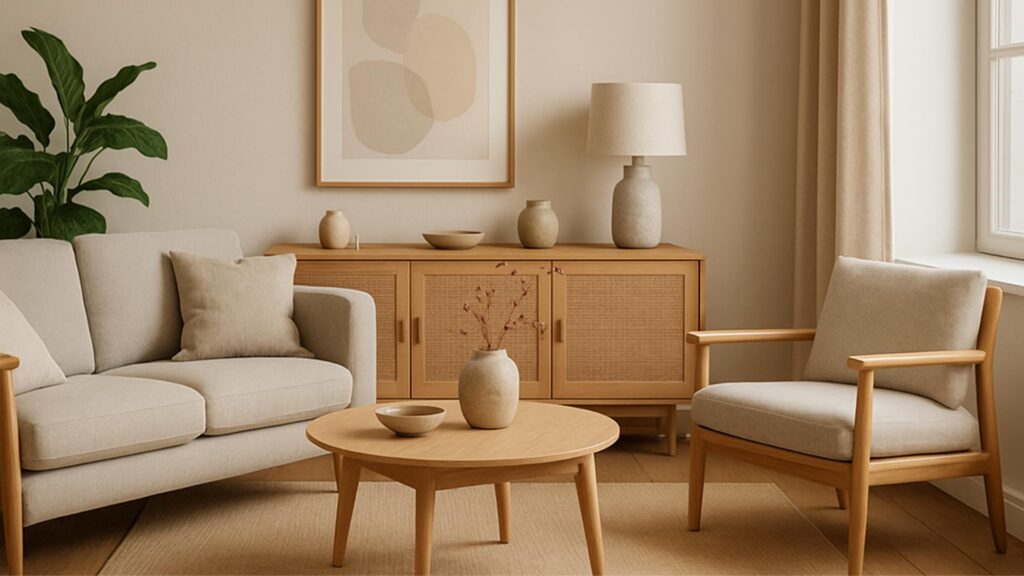
Three habits carry over well, and none of them require buying anything Nordic. The first is treating light as a layout problem: Nordic rooms are planned around a scarce winter daylight budget, so nothing tall blocks a window and pale surfaces sit where the light lands. The second is one wood, repeated. Picking a single species and sticking to it across floor, table and shelving does more for coherence than matching a palette. The third is the willingness to leave a surface empty because the object that would fill it has not earned its place yet.
What does not transfer is the shopping list. Buying a rattan basket, a sheepskin and a light oak sideboard produces a showroom, not a room someone lives in.
Where the style gets misread
The biggest misreading is that Scandinavian means beige. The export version that reached the rest of Europe in the 2010s was heavily filtered through flat-pack retail and photography, which favours low contrast and pale wood. Historic Nordic interiors are full of saturated colour, from Gustavian blue-greys to the deep reds of painted Swedish furniture, and current Nordic studios use colour freely.
The second misreading is that minimal means sparse. The canon is unsentimental about clutter but generous about texture and warmth, which is a very different thing from an empty room. A space that feels cold usually has a lighting problem, not a furniture problem.
Questions readers send us
Is Scandinavian design the same as minimalism?
No. Minimalism is a reduction principle applied to form. Scandinavian design is a regional tradition that happens to favour restraint, but it tolerates pattern, colour and visible craft in a way strict minimalism does not.
Why do the original pieces cost so much if they were made for mass production?
Licensed reissues carry royalty, tooling and materials costs that a copy does not, and the originals were never cheap in absolute terms. They were affordable relative to bespoke cabinetmaking, which was the alternative at the time.
Does it work in a small flat?
Unusually well, because most of the canon was designed for modest Nordic apartments rather than large houses. Stackable, wall-mounted and multi-position pieces were the norm from the start.
Is the look dated in 2026?
The pale, low-contrast interpretation is fading, and colour and darker woods are back in the mainstream. The underlying pieces are not affected by that, which is rather the point of the argument above.
So the honest answer to what makes it timeless is unromantic. A tight definition, a decade of coordinated promotion, and objects designed so that a factory could keep making them without changing the tooling. Everything else is downstream of that.
Wondering which pieces survive the next taste cycle?
Some of what the canon rejected is being reappraised right now, and not always kindly.
Sources: Design in Scandinavia travelling exhibition, 1954 to 1957; Lunning Prize records, established 1951 by Frederik Lunning; Fritz Hansen and Artek product histories for the Egg (1958) and Stool 60 (1933); Good Design award, 1950, for the Cobra lamp by Greta Magnusson Grossman. Updated August 2026.