
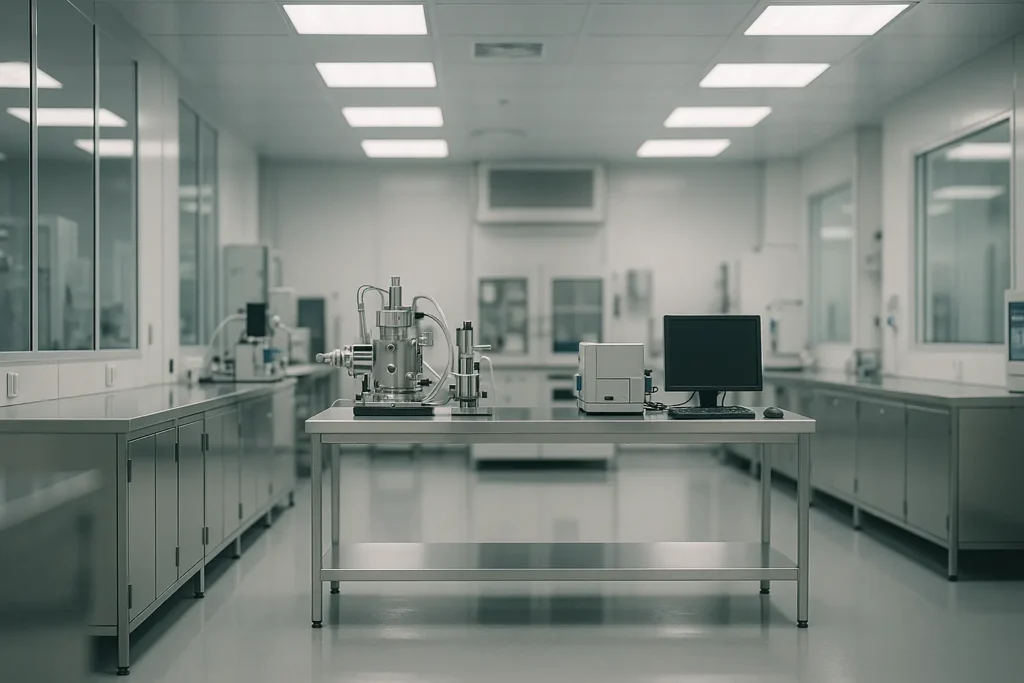
The room that gets all the headlines is a windowless box in Redmond where visitors report hearing their own blood move. It is genuinely the quietest place ever measured. It is also not the room that industry loses sleep over. The quiet that costs money is measured in picometres, not decibels, and almost nobody writes about it.
Key takeaways
- Microsoft’s Redmond chamber holds the Guinness World Record at −20.35 dBA, set in 2015.
- Fabs specify vibration, not sound, using VC curves devised in the early 1980s.
- EUV lithography tools need vibration amplitudes below roughly 50 picometres.
- Cleanroom classes under ISO 14644 count particles, and say nothing about noise.
Three kinds of quiet, routinely confused
Before any of the numbers make sense, the vocabulary has to be separated, because facility briefs conflate these constantly and the specifications that result are expensive and wrong.
- Acoustic quiet. Airborne sound pressure, in decibels. Anechoic chambers absorb reflections so a source can be measured without the room contaminating the result.
- Mechanical quiet. Structural vibration, expressed as velocity in one-third octave bands. This is what determines whether a nanometre-scale process holds alignment.
- Particulate quiet. Airborne contamination, counted per cubic metre at a given particle size. This is what “cleanroom” formally means.
Only the second one is routinely the binding constraint on production output, which is why it dominates fab budgets while the first gets the documentaries.
What Microsoft actually built in Redmond
The chamber at Microsoft’s Redmond headquarters was certified by Guinness World Records in 2015 with a background level of −20.35 dBA, roughly 20 decibels below the threshold of human hearing. Structurally it is six layers of concrete and steel isolating the room from the building, with fibreglass wedges across ceiling, walls and floor to break up sound waves before they can reflect. The principal designer was Hundraj Gopal, a speech and hearing scientist at the company, and the previous record had been held by Orfield Labs in Minneapolis, certified in 2004 and again in 2012.
Its purpose is prosaic and commercial. If you are measuring the acoustic signature of a keyboard, a fan curve, a headset or a far-field microphone array, you need a room that adds nothing to the measurement. The disorientation visitors describe, with the longest continuous stay reported at around 55 minutes, is a side effect rather than the point.
Why fabs specify picometres instead of decibels
Semiconductor fabrication rooms are not designed to be silent to a human ear. They are noisy places, full of air handling and tool exhaust. What they are designed to suppress is motion of the floor, because a stepper aligning features a few nanometres wide cannot tolerate the slab moving underneath it.
The framework everyone uses dates to the early 1980s, when Eric Ungar and Colin Gordon developed generic vibration criteria, the VC curves, expressed as one-third octave velocity spectra. Those curves became the shared language of the semiconductor, biomedical and metrology sectors, and are referenced through IEST-RP-CC012.3.
| Criterion | Velocity limit | Typical application |
|---|---|---|
| VC-D | 250 µin/s | General fab construction target |
| VC-E | 125 µin/s | Higher precision tooling and metrology |
| NIST-A | VC-E above 20 Hz, tighter below | Nanotechnology probe and lithography suites |
Modern EUV lithography sits beyond what passive construction alone delivers. Published design guidance puts the requirement at vibration amplitudes below roughly 50 picometres across the critical 1 to 30 Hz band, with High-NA EUV tooling tightening that toward 25 picometres. A picometre is one thousandth of a nanometre. At that scale, active isolation under the tool is not an upgrade, it is the only way the specification is met.
Where cleanrooms fit, and what they do not certify
A cleanroom is a controlled environment that limits airborne particles, microbes and chemical vapour, and its class is defined by particle count per cubic metre at a stated size under ISO 14644, running from ISO 1 as the cleanest to ISO 9. The machinery behind that is HEPA and ULPA filtration moving large volumes of air, positive pressure to keep unfiltered air out, gowning protocols, restricted access and continuous monitoring.
Notice what the classification does not include. Nothing in a cleanroom class says anything about decibels or vibration velocity. The filtration fans that hold the class are themselves a noise and vibration source, which is precisely the tension a facility engineer has to resolve. Cleanliness, quiet and vibration control pull against each other, and the trade-off is where the design skill actually sits. If you want the manufacturing chain that all this exists to protect, our walk through the secret life of a microchip covers what happens inside these rooms.
Specifying a facility without overbuying
The expensive mistake we see repeatedly is a brief that asks for a quiet room when it means a stable one. Anechoic treatment is costly and does nothing measurable for tool alignment. Conversely, a slab poured to VC-E is a very large capital line item, and it is wasted on a laboratory whose most sensitive instrument is a bench microscope.
The order of questions that avoids both errors: identify the single most sensitive instrument that will ever occupy the room, find its manufacturer’s environmental specification, and specify to that number rather than to a general ambition of quiet. Then check whether the requirement is airborne, structural or particulate, because those three answers buy three completely different buildings.
Questions that come up
What exactly is a cleanroom and why is one needed?
It is a room engineered to hold airborne contamination below a certified level, used where a stray particle ruins the product. Semiconductors, pharmaceuticals, biotechnology, aerospace and medical devices are the main users.
How is cleanliness classified?
By counting particles per cubic metre at a specified particle size, under the ISO 14644 scale running from ISO 1 to ISO 9. The class is a measurement result, not a design description.
Is an anechoic chamber a cleanroom?
No. The two solve unrelated problems and are rarely combined. An anechoic chamber controls sound reflection; the wedge material and the isolated construction have nothing to do with particle counts.
Can a room be too quiet to work in?
For people, effectively yes. Extended time in a fully anechoic space is disorienting for most visitors, which is why measurement sessions are short and the rooms are not used as workspaces.
The takeaway we would leave with any facility team: decide which of the three quiets your process actually needs before anyone prices a wedge, a slab or a filter bank. Silence is the least of them.
Curious what else goes into a modern plant?
Environmental control is one layer of what separates a next-generation facility from a conventional one.
Sources: Guinness World Records, world’s quietest place, October 2015; Colin Gordon Associates and IEST-RP-CC012.3 on vibration criteria curves developed by Eric Ungar and Colin Gordon; published EUV and High-NA EUV facility design guidance; ISO 14644 cleanroom classification. Updated August 2026.