
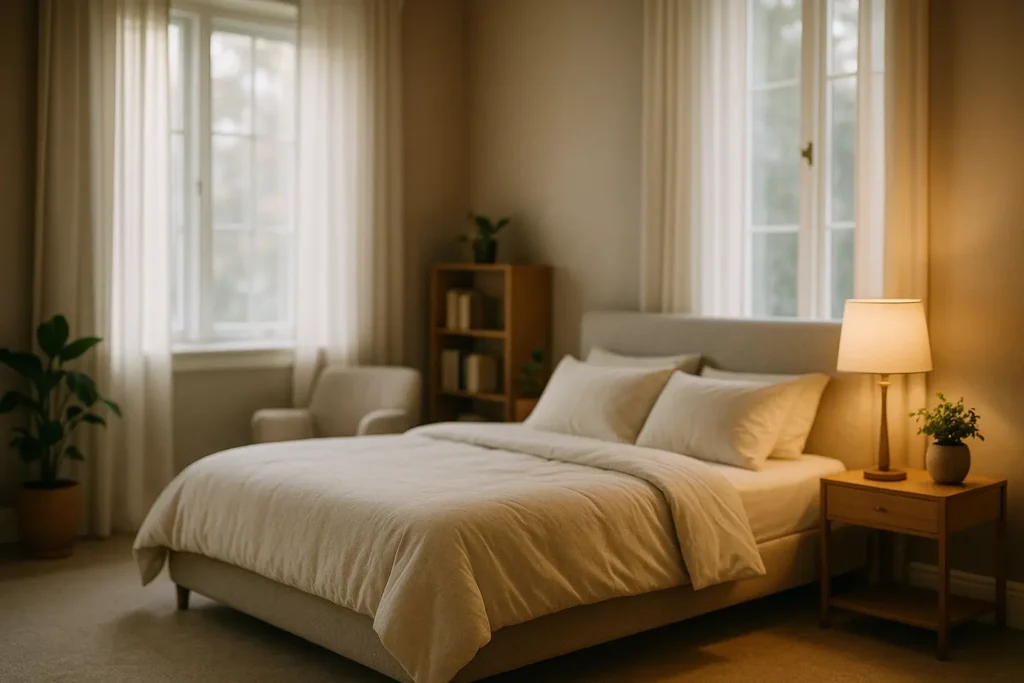
Search for bedroom design and sleep, and within three clicks you will meet the same statistic: people with blue bedrooms sleep seven hours and fifty-two minutes a night. It is repeated so confidently that almost nobody checks where it comes from. We did, and the answer reorganised how we now rank the design decisions that actually affect a night’s rest.
Key takeaways
- Evening room light measurably suppresses melatonin, according to a 2011 clinical study.
- A commonly cited comfortable range is 65 to 68 °F, roughly 18 to 20 °C.
- The famous blue bedroom figure comes from a 2013 hotel chain survey, not a controlled trial.
- Dimmers and blackout fabric change more than a repaint does.
Ranked by evidence, not by mood board
Not every design lever carries the same weight, and treating them as equivalent is how people end up repainting a room that needed a curtain rail. Here is how we would rank the four usual suspects by the strength of what stands behind them.
| Design lever | What it acts on | Strength of evidence |
|---|---|---|
| Evening and night light | Melatonin timing, circadian signal | Clinical, controlled |
| Room temperature | Core body temperature drop | Well documented, individual variation |
| Wall colour | Perceived calm, light reflectance | Survey level, self-reported |
| Layout and clutter | Perceived calm, bedtime habits | Mostly anecdotal |
Light: the lever with the hardest science behind it
Ordinary domestic lighting in the evening is enough to move your body clock. In a study published in The Journal of Clinical Endocrinology & Metabolism in March 2011, Joshua Gooley and colleagues exposed 116 healthy volunteers aged 18 to 30 to either room light or dim light during the eight hours before bedtime, across five consecutive days. Room light suppressed melatonin and shortened the body’s internal representation of night.
What that means for a bedroom is unglamorous and cheap. Put the main ceiling fitting on a dimmer, or stop using it after dark and let two low lamps at roughly mattress height carry the room. Choose warm bulbs in the 2200 to 2700 kelvin range for those lamps. Lined blackout curtains or a blackout roller blind behind an existing curtain will do more for a light-polluted street-facing room than any repaint, and lined fabric has the side benefit of damping traffic noise.
The reverse also matters in the morning. Leave one window unobstructed so daylight reaches the bed early, because the contrast between a dark night and a bright morning is what the clock reads. If you want to think through the fixture layer properly, our guide to the secret to layered lighting covers how the three tiers work together.
Temperature: the setting most people miss by a couple of degrees
A bedroom that is slightly too warm blocks the core body temperature drop that precedes sleep. The Sleep Foundation reports that most doctors suggest keeping the thermostat between 65 and 68 °F, roughly 18 to 20 °C, and notes that the ideal setting is genuinely personal rather than universal. Research it cites also indicates that older adults often sleep better somewhat warmer, in a 68 to 77 °F band.
Design decisions feed straight into this. Heavy layered bedding in a small, well-insulated room will overshoot the target even with the heating off. Linen and percale cotton shed heat far better than jersey or brushed cotton, and a duvet in two seasonal weights costs less than the mattress people usually blame. A ceiling fan on its lowest setting is quieter than most standing fans and moves air without a draught across the pillow.
Colour: where that famous number actually comes from
The seven hours and fifty-two minutes figure traces back to a Travelodge survey of 2,000 British bedrooms published in 2013, which also reported that 55% of people with blue rooms woke up happy. It is an observational survey run by a hotel chain, not a controlled experiment, and it cannot separate wall colour from everything else those households did differently. Treat it as a talking point rather than a finding.
What survives scrutiny is duller and more useful: what a wall colour changes reliably is how much light it throws back into the room. A deep, low-reflectance shade makes a small evening lamp feel sufficient, which is exactly the behaviour you want after dark. That argues for depth and matt finish over any particular hue, and it means a charcoal or forest-green bedroom is a defensible choice rather than a rebellious one.
Layout and clutter: real comfort, thin evidence
We are not aware of controlled trials showing that bed position changes sleep architecture, and we would be sceptical of anyone who claims otherwise. What layout does change is the friction around bedtime. A bed you can make from both sides gets made; a nightstand wide enough for a book and a glass keeps the phone off the mattress; a clear route to the door in the dark removes the small night-time alertness of navigating obstacles.
Plants belong in the same category. They make a room pleasant to be in and they do not measurably alter the air in a domestic bedroom overnight, whatever the planter-shop copy says.
Straight answers to what readers ask us
Does painting a bedroom blue improve sleep?
There is no controlled evidence that a specific hue improves sleep. The widely quoted blue bedroom statistic comes from a 2013 hotel survey. Colour depth and finish, which govern how much lamp light bounces around the room at night, are the part worth thinking about.
What should I fix first if I only change one thing?
Light after dark. Add a dimmer or switch to two warm low lamps, and block external light at the window. It is the cheapest intervention with the strongest evidence behind it.
Is a cooler bedroom always better?
Cooler than a living room, yes, but not indefinitely. Around 65 to 68 °F suits most adults, while older sleepers often do better warmer. Bedding weight is usually the easier variable to adjust than the thermostat.
Do blackout curtains help if the room is already dim?
Only marginally for melatonin, but lined heavy fabric also cuts noise and slows heat loss at the glazing, so it often earns its place for reasons that have nothing to do with light.
If we had to compress all of it: design the dark, then design the temperature, then decorate. The room can look exactly as you want once those two are handled, which is a more liberating conclusion than the colour rules suggest.
Still curious about what colour does in a home?
Beyond the bedroom, palette choices say a fair amount about how a household actually lives.
General information on home design, not medical advice. Persistent insomnia or daytime sleepiness is worth raising with a doctor rather than a decorator. Sources: J. J. Gooley et al., Exposure to Room Light before Bedtime Suppresses Melatonin Onset and Shortens Melatonin Duration in Humans, The Journal of Clinical Endocrinology & Metabolism, March 2011; Sleep Foundation, guidance on the best temperature for sleep; Travelodge bedroom survey, 2013. Updated August 2026.