
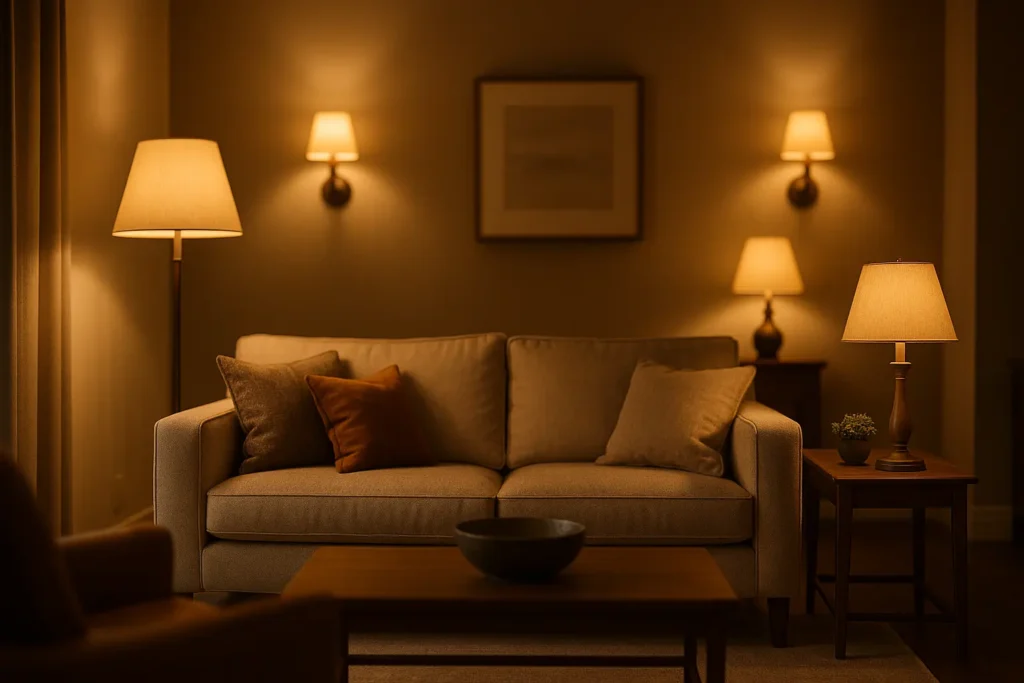
“Lighting is the jewellery of interior design” is the line that opens roughly every feature written on the subject, ours included, once upon a time. It is a nice image and it explains nothing. What actually separates a room that works after dark from one that never quite does is a small set of numbers that almost no domestic lighting article prints.
Key takeaways
- Lux is lumens per square metre, so the figure on the box tells you nothing on its own.
- Illuminance falls with the square of the distance, which is why height decides everything.
- EN 12464-1 sets 500 lux on the task area, UGR 19 and Ra 80 for work places, not homes.
- Accent light only registers when it is several times brighter than the surface around it.
What the three layers are actually doing
Each layer answers a different question, and mixing them up is the most common reason a room feels wrong without anyone being able to say why.
Ambient light: the level you move around in
Ambient lighting is the background illuminance of the room, usually from ceiling fittings, uplighters or a large diffuse source. Its job is orientation and safety, not work. It should be even enough that you are not walking between bright patches and dark ones, and dim enough that it can be left on all evening without becoming the thing you notice.
Task light: the only layer with a published number
Task lighting is the concentrated output on the surface where something is being done: a worktop, a desk, a book. This is the one layer that has a hard reference. The European workplace lighting standard EN 12464-1, in its 2021 edition, specifies a maintained illuminance of 500 lux on the task area for writing, typing, reading and data processing, with glare kept at a unified glare rating of 19 or below and colour rendering of Ra 80 or above. That standard covers indoor work places, not dwellings. No equivalent binding figure exists for a private kitchen or living room, which is precisely why domestic lighting advice can contradict itself indefinitely without anyone being provably wrong.
Accent light: the layer that fails silently
Accent lighting picks out a wall texture, a shelf or a picture. It works on contrast, not on output: if the surface it hits is only slightly brighter than everything around it, the effect disappears entirely and you have simply added another lamp. This is the layer people install first and notice least.
| Specification | What it measures | Reference point |
|---|---|---|
| Lumens | Total light leaving the lamp | Declared on the EU energy label since 1 September 2021 |
| Lux | Lumens landing on one square metre of surface | 500 lux on the task area, EN 12464-1 office tasks |
| UGR | Discomfort glare from the fitting itself | 19 or below for office task areas, EN 12464-1 |
| Ra, or CRI | How accurately colours read under the lamp | 80 or above for general work, EN 12464-1 |
| Correlated colour temperature | Warm to cool appearance, in kelvin | No standard value, a design choice per room |
Why one ceiling fitting can never do the job
Illuminance from a point source falls with the square of the distance. Move a lamp from half a metre above a worktop to two metres, and the light landing on that worktop drops to roughly a sixteenth of what it was. That single relationship explains most of the frustration people have with their lighting, and it is why the answer is almost never a brighter ceiling fitting.
To reach a working level on a worktop from ceiling height, the fitting has to flood the entire room at that intensity. The kitchen then becomes uncomfortable to sit in, and the only remaining control is a switch that turns everything off. Put the same output 40 centimetres above the surface, under a cabinet or on an adjustable arm, and you get the working level exactly where it is needed while the rest of the room stays at a level you can live with. The layers are not decoration. They are the mechanism that lets one room hold two very different brightness requirements at once.
The lumen figure on the packaging is what you have to work with when buying, since it has been mandatory on the EU energy label for light sources since Regulation (EU) 2019/2015 and the matching ecodesign rules took effect on 1 September 2021. It tells you what leaves the lamp. What arrives on the surface depends on distance, reflector shape and the colour of the walls, which is why two rooms fitted with identical bulbs can measure very differently.
Room by room, before buying anything
- Kitchen. Keep the ceiling fitting for circulation only and put the real output under the wall cabinets, at worktop level. Pendants over an island read as accent and general light at once, but they sit too high to count as task light unless they hang low enough to be in the way of nobody.
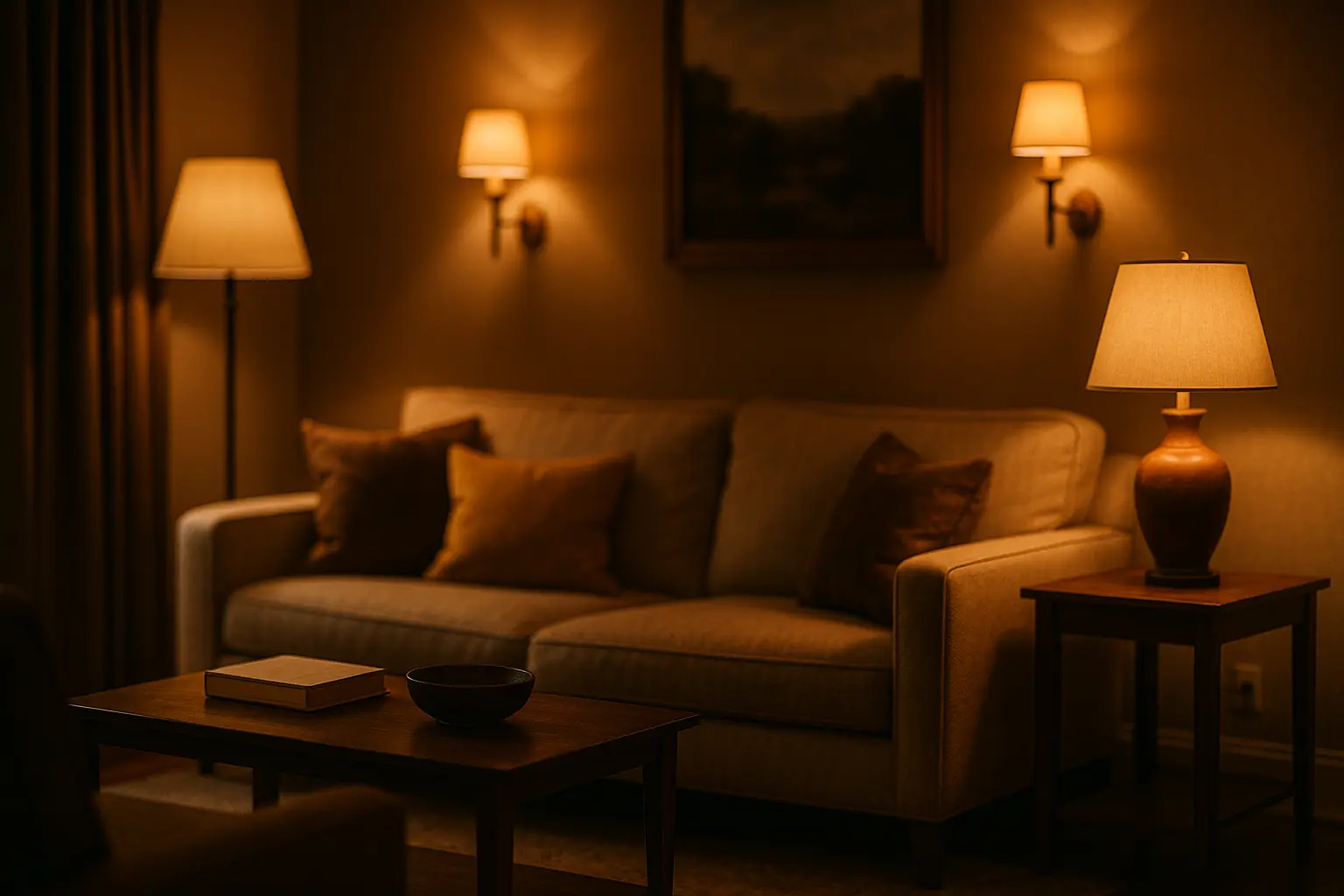
- Living room. This is the room with the widest range of uses, so it needs the most switching. Two or three separate low-level sources, each on its own switch, beat one bright central fitting on a dimmer, because they let you change the shape of the light rather than just its quantity.
- Bedroom. Low ambient level, a genuinely directional reading light beside the bed rather than a soft glow, and nothing bright at eye height. Bedside output that spills across the room is the single most common complaint we hear about bedroom schemes.
- Hallway. Wall-mounted light at low level reads better than an overhead fitting, because a corridor lit from above shows every unevenness in the ceiling and flattens the walls.
Anyone applying the same logic to a desk will find the numbers set out in more detail in our notes on building a home office you actually want to work in, where the workplace standard applies more directly.
What we get asked about layering light
How many layers does a room really need?
Three is the working convention, and it holds because it maps onto three distinct jobs rather than three fixtures. A small hallway may only need two. A kitchen with an island and a dining end often runs four or five circuits, and calling that a fourth layer is a naming argument rather than a design one.
Do smart bulbs replace the need for layers?
No. A colour-changing bulb still sits in the same position on the ceiling, and the inverse square relationship does not care how the lamp is controlled. Tunable output makes a good layout more flexible. It does not fix a bad one.
Is warm light always right for a home?
Not always, and there is no standard figure to appeal to here. Warmer tones read as domestic and are the safe default for living areas. Cooler, higher-output light on a worktop or a bathroom mirror makes detail easier to see. Mixing colour temperatures within a single sightline is what looks wrong, not the choice itself.
Are the old fluorescent under-cabinet strips still an option?
Not as a new purchase in the EU. Under the RoHS Directive, pin-based compact fluorescent lamps came off the market in February 2023 and T5 and T8 fluorescent tubes followed in August 2023, on mercury content grounds. Replacement is now an LED question by default.
Wondering how far the same choices reach into how you sleep?
Light at the wrong time of day turns out to matter more than light at the wrong colour.
Sources: EN 12464-1, Light and lighting, lighting of work places, indoor work places, 2021 edition, for the 500 lux maintained illuminance on the task area, the UGR limit of 19 and the colour rendering index of 80 for general office tasks, and for the recommended illuminance scale in steps; Commission Delegated Regulation (EU) 2019/2015 on energy labelling of light sources and Commission Regulation (EU) 2019/2020 on ecodesign requirements for light sources, both applicable from 1 September 2021, for the declaration of luminous flux; Directive 2011/65/EU on the restriction of hazardous substances, for the end of exemptions covering pin-based compact fluorescent lamps in February 2023 and T5 and T8 linear fluorescent lamps in August 2023. EN 12464-1 states requirements for indoor work places and is cited here as a reference point, not as a rule applicable to private dwellings. Updated August 2026.