
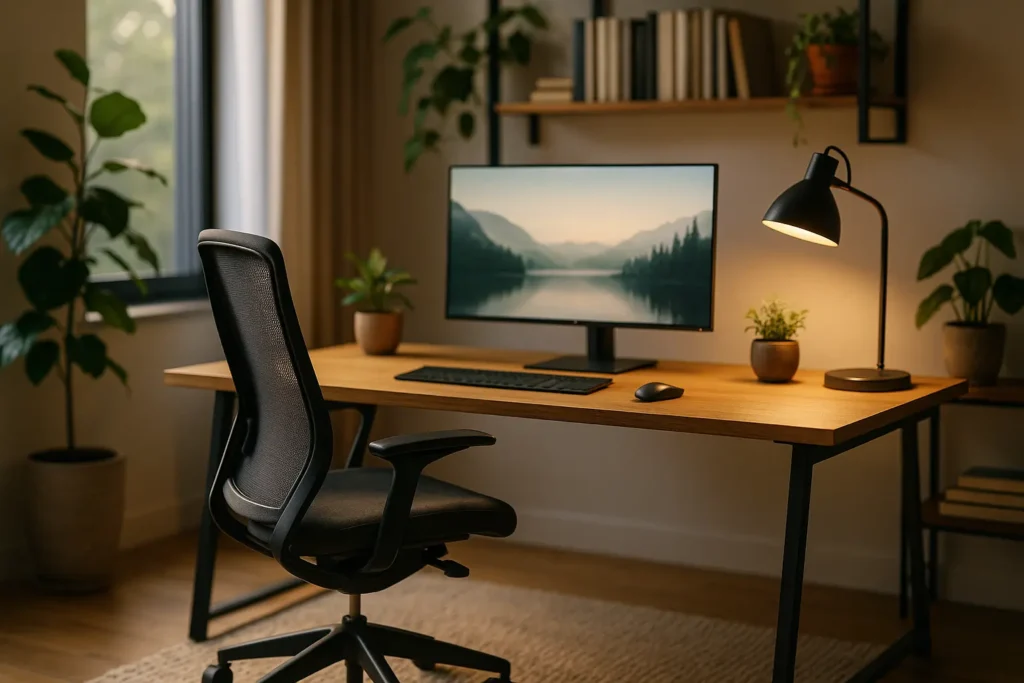
Almost every home office guide is, underneath, a shopping list. Buy the chair, buy the lamp, buy the plant, buy the cable box. What is striking when you compare that advice against the published workplace standards is how few of the recommendations carry a number, and how much of the disagreement disappears once you introduce one.
Key takeaways
- EN 12464-1 sets 500 lux maintained on the task area for reading, writing and screen work.
- OSHA puts the preferred eye-to-screen distance at 20 to 40 inches, or 50 to 100 cm.
- The top line of the screen belongs at or below eye level, not above it.
- Potted plants do not measurably clean indoor air. Opening a window does.
Start with the two numbers nobody puts in the mood board
Lighting is the single most common failure we see in home setups, and it is the easiest to fix without buying furniture. The European standard for indoor workplace lighting, EN 12464-1, sets a maintained illuminance of 500 lux on the task area for writing, typing, reading and data processing. The task area is the desk surface, roughly 0.75 m above the floor, not the ceiling and not the room average. Most domestic rooms are lit to a fraction of that, because they were designed for relaxing in.
The second number concerns geometry. The OSHA computer workstation guidance puts the preferred viewing distance at 20 to 40 inches, or 50 to 100 cm, measured from the eye to the front of the screen, with the top line of the screen at or below eye level. Screens set too close or too high pull the head and torso into positions that produce the aches people then blame on the chair.
| What to check | Target | Where it comes from |
|---|---|---|
| Light on the desk surface | 500 lux maintained | EN 12464-1, indoor workplace lighting |
| Glare from luminaires | UGR of 19 or below | EN 12464-1, office task category |
| Colour rendering of the lamp | Ra of 80 or above | EN 12464-1, general office work |
| Eye to screen distance | 50 to 100 cm | OSHA computer workstations guidance |
| Screen height | Top line at or below eye level | OSHA computer workstations guidance |
The plant question, answered properly
The claim that houseplants purify the air of a room is repeated in nearly every home office feature, and the evidence does not support it. Bryan Cummings and Michael Waring reviewed twelve chamber studies in the Journal of Exposure Science and Environmental Epidemiology in 2020 and converted 196 published results into a common measure, clean air delivery rate. The median for a single plant came out at 0.023 cubic metres per hour. To match what ordinary air exchange between indoors and outdoors already does, you would need somewhere between 10 and 1,000 plants per square metre of floor.
That is not an argument against plants. It is an argument against treating them as ventilation. Keep them because a room with something living in it reads differently, and because a large plant is one of the few objects that can mark the edge of a working zone without a wall. Then open a window, which is the intervention that actually moves the numbers.
Where the room has to stop
The design problem specific to working from home is not decoration. It is that the office has no closing time and no door. A dedicated room solves it. Where there is no spare room, the substitute is a visual and physical boundary that can be switched off: a screen that folds, a cabinet that shuts on the monitor, a rug that ends the zone, a lamp that is only ever on during working hours.
This is also where storage earns its place. Shelving and drawers are usually sold as tidiness, but their real function in a shared room is compression, letting the working surface disappear in under a minute. If clearing the desk takes ten minutes, it will not happen, and the room never stops being an office. Anyone working in a genuinely tight footprint will find the same logic applied at room scale in our notes on designing small spaces without feeling cramped.
A thirty-minute pass on the desk you already have
Before spending anything, run the setup you own through five checks. Most people find two or three of them are wrong, and all five are free.
- Move the desk relative to the window, not the wall. Facing a window puts glare in your eyes, backing onto it puts glare on the screen. Side-on is the position that works in both.
- Raise the screen. Books work. Aim for the top line at or just below eye level, then push the screen back until it sits in the 50 to 100 cm band.
- Add a task light, not a brighter ceiling light. Reaching 500 lux on the desk with a single overhead fitting means over-lighting the whole room.
- Set the chair to the desk, then the screen to the chair. Feet flat, forearms roughly level with the surface. The order matters, because adjusting in the reverse direction always ends with the wrong screen height.
- Decide what closes. Pick the one object that signals the end of the day, and use it every day.
Before you buy anything else
Is natural light enough on its own?
Rarely, and not reliably. Daylight is excellent while it lasts, but it is unmeasured, directional and gone by mid-afternoon for much of the year. The standards specify maintained illuminance for exactly that reason: the figure has to hold at the worst moment, not the best.
Does an expensive chair fix back pain?
Not by itself. A chair that adjusts to your desk height and supports the lower back is worth having, but a well-specified chair under a screen that is too high or too close will still produce neck and shoulder strain. Fix the geometry first, then judge the chair.
What about a standing desk?
It changes the posture rather than removing the problem. The same distance and eye-level rules apply standing, and they are easier to get wrong, because most people set the desk height by feel and leave the screen where it was.
Do the styling choices matter at all?
Yes, but at a different level. Colour, texture and personal objects influence whether you want to be in the room. Light and geometry influence whether you can work there without paying for it later. The first is preference and the second is not, and the mistake is treating them as the same kind of decision.
Curious how far a room can push output?
The research on rooms and cognitive performance is more specific, and more limited, than the productivity literature suggests.
Sources: EN 12464-1, Light and lighting, lighting of work places, indoor work places (2021 edition), for the 500 lux maintained illuminance on the task area in offices, the UGR limit of 19 and the colour rendering index of 80 for general office tasks; United States Occupational Safety and Health Administration, Computer Workstations eTool, monitors section, for the preferred viewing distance of 20 to 40 inches (50 to 100 cm) and the top line of the screen at or below eye level; Cummings, B. E. and Waring, M. S. (2020), “Potted plants do not improve indoor air quality: a review and analysis of reported VOC removal efficiencies”, Journal of Exposure Science and Environmental Epidemiology, 30, review of 12 chamber studies and 196 experimental results, median single-plant clean air delivery rate 0.023 cubic metres per hour, requiring 10 to 1,000 plants per square metre of floor to match building air exchange. Lighting and ergonomics standards state target values for work places, not guaranteed health outcomes for any individual, and persistent pain is a matter for a clinician rather than a furniture decision. Updated August 2026.