
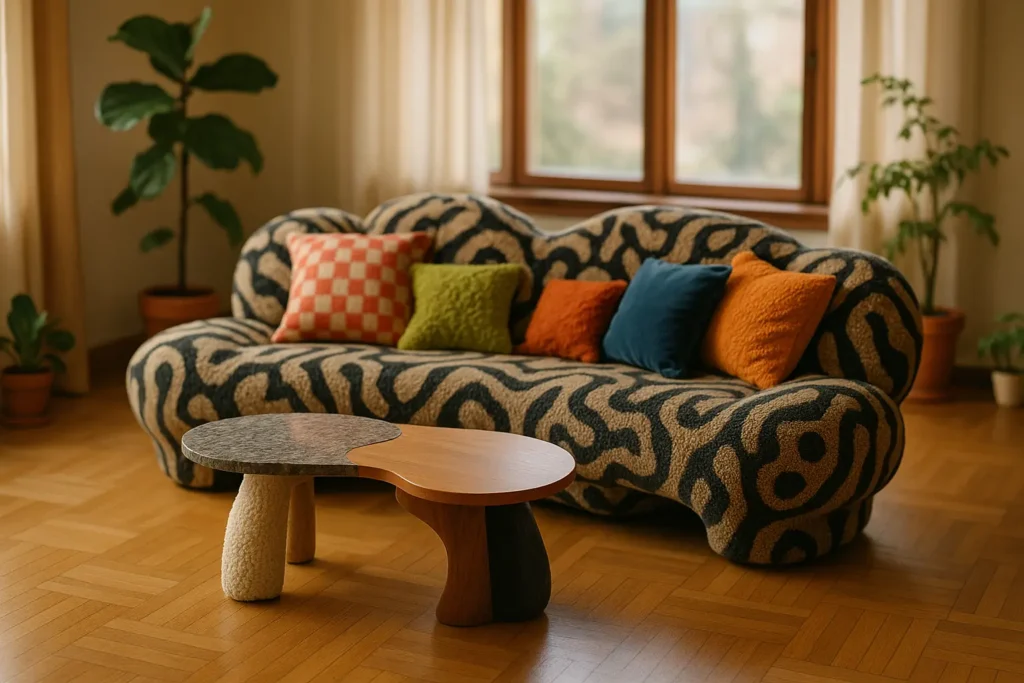
Chocolate brown was the colour of choice for 33% of the interior designers 1stDibs surveyed for its 2026 trends report, published in November 2025. Four years earlier the same question put it at 17%. Somewhere between those two numbers, the shade that estate agents once told people to paint over became the one clients ask for by name. That is the whole “ugly furniture” story in miniature: the word describes a moment, not an object.
Key takeaways
- Maximalism (39%) and eclecticism (38%) topped the 1stDibs designer survey for 2026.
- 36% of items designers sourced in 2025 were vintage or antique, the highest share since 2021.
- 43% named curvy or irregular furniture shapes as a look they expect to keep using.
- Furniture and furnishings ran to 12.1 million tons of US waste in 2018, 80.1% of it landfilled.
Ugly is a market position, not a mistake
The pieces now called ugly are almost always pieces that fell out of fashion while still being well made. That combination is what creates the opening. A carved oak sideboard from the 1930s and a mass-market veneered unit from last year can sit at similar prices in a resale listing, and only one of them has solid timber, mortise and tenon joints and another eighty years in it.
The 1stDibs figures back up how far this has travelled from novelty. Across 468 designers surveyed in July and August 2025, maximalism was named by 39% and eclecticism by 38%, ahead of anything tidier. On average 36% of everything they specified in 2025 was vintage or antique, the strongest showing in five years, with 85% using vintage pieces made between the 1920s and 2000 and 63% reaching further back into genuine antiques.
Three lineages hiding under one word
Calling all of it “ugly furniture” flattens three very different things, and knowing which one you are buying changes what you should pay and how you should look after it.
The Memphis lineage: colour as an argument
Memphis started in December 1980, when Ettore Sottsass gathered a group of younger designers at his flat on Via San Galdino in Milan. The collection debuted at the Arc ’74 showroom on 18 September 1981 and defined the decade’s most divisive look. The emblem of it, the Carlton room divider, is a stack of angled shelves in laminated MDF, nearly two metres tall and almost as wide, produced as an unlimited edition. Originals and their many descendants share one practical trait worth knowing: laminate over MDF chips at the edges and cannot be sanded back, so condition on the corners is the whole ballgame.
The Brutalist lineage: weight you can feel
The dealer label “Brutalist” mostly points at the American work of Paul Evans (1931 to 1987) and the makers around him. His Patchwork cabinets, torch-cut sheets of brass, pewter and copper fixed to a handmade carcass, ran for Directional from 1964 into the 1970s, followed by the Argente pieces in welded aluminium and the boxy, mosaic-faced Cityscape series. These are heavy. Genuinely heavy. Measure your stairwell before you fall in love with a credenza.
The brown furniture lineage: the one your grandmother had
This is the cheapest entry point and the one moving fastest. Dark mahogany, walnut and oak spent two decades being the thing people painted white. The interest returning to it is partly aesthetic and partly a reaction to how flat-pack veneer ages. Buy it on the joints and the veneer, not the polish, since a tired surface is a weekend of work and a split carcass is not.
Putting one loud piece into a room without wrecking it
The mistake we see most often is treating a statement piece as decoration rather than as furniture that has to work. A sequence that holds up in practice:
- Pick the sightline first. Stand where you enter the room and where you sit most. One assertive object per sightline is the ceiling. Two competing ones read as indecision rather than confidence.
- Check it physically before it charms you. Doorway width, stair turn, lift depth. Then joints, frame rigidity when you rock it, and on anything upholstered, whether the foam has gone crumbly at the edges, which means a re-foam on top of the purchase price.
- Give it dull neighbours on purpose. A vivid laminate cabinet needs matt walls and plain textiles around it. That is not timidity, it is what lets the eye register the shape instead of fighting the room.
- Repeat one of its colours twice, quietly. A cushion welt and a book spine are enough. The piece stops looking marooned without anyone being able to say why.
- Confirm it actually functions. A sculptural chair nobody sits in becomes resented within a month. Sit in it for ten minutes in the shop, not ten seconds.
The sustainability claim, and the part of it that is marketing
The circular argument here is real, and it is bigger than most people assume. The US Environmental Protection Agency put generation of furniture and furnishings at 12.1 million tons in 2018, 4.1% of all municipal solid waste, with 80.1% of it going to landfill and effectively none of it recycled. Buying a piece that already exists genuinely removes a new one from that stream.
What we would not claim is that every vintage purchase is a green purchase. A stripped and refinished cabinet involves solvents, a reupholstery involves new foam and fabric, and a piece shipped across a continent has a freight cost attached. The honest version is narrower and still worth saying: the most sustainable sideboard is almost always the one that is already built, bought locally, and kept for twenty years.
Questions we get on this
Is any of this actually a good investment?
Treat it as furniture you enjoy, not as an asset. Signed pieces by documented makers have held value, but that market rewards provenance, condition and rarity, three things most reasonably priced finds do not have. If resale value is the point, buy the name and the paperwork, not the look.
How do I tell a period piece from a recent copy?
Look underneath. Period construction shows saw marks, uneven staining, older screw types and hardware that was fitted before the finish. Reproductions tend to have machine-perfect undersides, staple-fixed backs and consistent modern fixings throughout.
What if my partner genuinely hates it?
Then it belongs in a room they use less, or it does not come home. We say that without irony. The pieces in this category are strong enough that living with one you have to defend daily is a slow way to fall out with an object you paid for.
Will this look dated in five years?
Probably, in the sense that the framing around it will change. That is fine. The furniture that survives style cycles is the furniture that was well built, and most of what is being rediscovered now is being rediscovered precisely because it was.
Wondering how far the more-is-more mood actually goes?
Maximalism topped the designer survey for 2026, which raises an obvious question about where that leaves the alternative.
Sources: 1stDibs 2026 Interior Design Trends Survey, published 17 November 2025, based on 468 online interviews with designers in the 1stDibs Trade Program conducted in July and August 2025, for maximalism at 39%, eclecticism at 38%, chocolate brown at 33% against 17% in 2022, vintage and antique sourcing at 36% of items, and curvy or irregular furniture at 43%; Design Museum and Dezeen for the founding of Memphis in December 1980 and its debut on 18 September 1981, and for the Carlton room divider of 1981; 1stDibs designer biography for Paul Evans (1931 to 1987) and the Patchwork, Argente and Cityscape series produced for Directional; US Environmental Protection Agency, Durable Goods Product-Specific Data, for 12.1 million tons of furniture and furnishings generated in 2018 and 80.1% landfilled. If you like a piece that nobody else does, that is taste, not an error. Updated August 2026.