
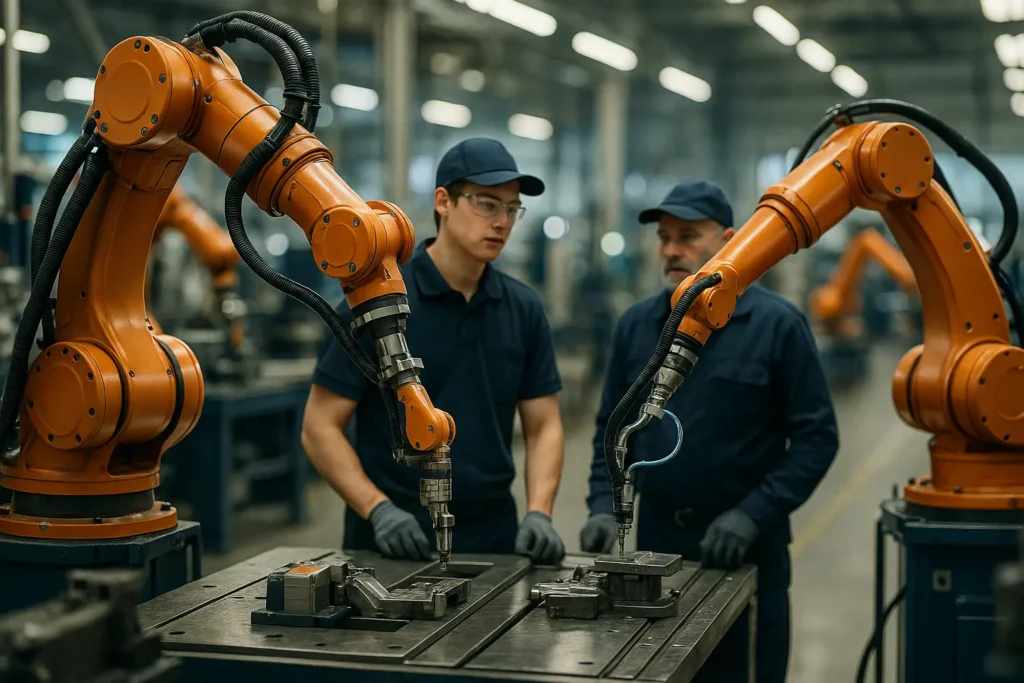
One humanoid robot spent the best part of a year at BMW Group Plant Spartanburg lifting sheet metal into position ahead of the welding line. Ten-hour shifts, Monday to Friday. BMW says its work ran across production of more than 30,000 X3 vehicles. That deployment is the most concrete public answer anyone has to the question in this headline, and what it shows is considerably narrower than the coverage suggested at the time.
Key takeaways
- 542,076 industrial robots were installed worldwide in 2024, a fourth straight year above half a million units.
- Collaborative robots, built to work beside people rather than behind a fence, were 10.5% of installations in 2023.
- Korea runs 1,220 robots per 10,000 manufacturing employees and still hires manufacturing workers.
- Up to 1.9 million US manufacturing posts could go unfilled by 2033 for lack of candidates.
What ten months at Spartanburg actually proved
It proved that a humanoid can hold one station reliably, and that is not the same claim as replacing a worker. BMW Group ran the first humanoid deployment at one of its plants in 2025 at Spartanburg, South Carolina, with Figure AI’s Figure 02. The task, in BMW’s own description, was the removal and precise positioning of sheet metal parts for the welding process, work that is demanding on speed and accuracy and physically exhausting for people.
Read the job description again, because the answer to the bigger question is hiding inside it. One station. One material family. One motion, repeated across a shift. BMW has since put the successor model, Figure 03, onto logistics sequencing work at the same plant, and started a humanoid at Plant Leipzig, its first in Europe. Every one of those steps extends the machine into another well-bounded task. None of them adds up to a general-purpose factory worker.
Robot density says more than robot headlines
Density tells you where automation has genuinely landed, and the picture is lopsided. The International Federation of Robotics counted 542,076 industrial robots installed worldwide in 2024, the fourth consecutive year above half a million units, with Asia taking 74% of new deployments and China alone accounting for 54% of the global total.
Per-worker density is the more revealing measure. Korea reported 1,220 robots per 10,000 manufacturing employees, ahead of Singapore at 818 and Germany at 449. Regionally, Western Europe averaged a record 267, North America 204 and Asia 131. To our reading, the interesting fact is not the gap between those numbers but what sits underneath the highest one: the most heavily automated manufacturing economy on the planet still employs a large manufacturing workforce, and still competes for it.
| Type of work | Why it does or does not automate | What the person ends up doing |
|---|---|---|
| Placing a known rigid part, thousands of times | Fixed geometry, fixed tolerance, no ambiguity in the grasp | Changeovers, programming, quality sign-off |
| Visual inspection for a known defect class | Learnable from labelled examples once the defect is defined | Adjudicating edge cases and false positives |
| Handling soft, deformable or tangled material | Grasp planning stays unreliable when the object changes shape as you touch it | Most of it, still manually |
| First-off setup after a product change | Every change is effectively a one-off, so there is nothing to learn from repetition | Engineering judgement and trial runs |
| Working out why the line stopped | Causes are ambiguous and often physical, upstream or human | All of it, usually the person who knows the machine best |
The shortage is the reason, not the payroll saving
Most of the automation being bought right now is being bought because the shift cannot be staffed. The Deloitte and Manufacturing Institute study published in April 2024 put the requirement at up to 3.8 million manufacturing workers between 2024 and 2033, and warned that more than five in ten of those skilled openings, around 1.9 million roles, could stay empty if the workforce pipeline is not fixed.
That reframes the debate. A plant that cannot fill a night shift is not choosing between a robot and a person. It is choosing between a robot and an idle line. Anyone selling automation on headcount reduction alone, in that context, is answering a question the operations director did not ask. The same logic runs through the way plants now schedule their maintenance windows, which we looked at when covering what predictive maintenance actually changes on the floor.
What the job actually becomes
It becomes more technical, and the transition is the part employers keep underestimating. The World Economic Forum’s Future of Jobs Report, published in January 2025 from a survey of 1,000 employers across 22 industries and 55 economies, projected 170 million roles created and 92 million displaced by 2030, a net gain of 78 million, alongside 39% of existing skills being transformed or made obsolete within five years. Those are employer expectations rather than measured outcomes, and worth reading as such.
The hardware is moving the same way. Collaborative robots, the ones designed to share floor space with people instead of being caged off, made up 10.5% of industrial robots installed worldwide in 2023. That share is the clearest signal in the data of where this is heading: not a floor without people, but a floor where the fence between the two has been removed.
Questions we get on this
Is a humanoid robot better than a fixed industrial arm? Rarely, on cost per cycle. A caged arm bolted to the floor is faster, cheaper and more reliable for a task that never moves. The case for a humanoid is that it can be redeployed across stations built for human bodies, which matters most in older plants that would be expensive to re-engineer.
Which jobs are genuinely at risk? Narrow, high-volume, low-variation ones, where the same physical action repeats without judgement. Roles that combine several of those actions with problem solving, changeovers or responsibility for output quality have held up much better in the deployment record so far.
How long does a deployment take to pay back? There is no honest general answer, and we would treat any single figure quoted at you as marketing. Payback depends on shift pattern, cycle time, product mix and how much line modification the installation needs, which is why credible vendors quote it per site after a survey.
What should a worker learn now? The skills that sit next to the machine rather than in front of it: cell programming and teaching, robot safety and risk assessment, basic vision system tuning, and reading process data well enough to spot drift before it becomes scrap.
Wondering what actually shares the floor with your team?
The fenceless machines now taking a tenth of all robot installations have their own working rules.
Sources: BMW Group press releases on the first humanoid robot deployment at Plant Spartanburg with Figure AI’s Figure 02, ten-hour shifts and production of more than 30,000 BMW X3, on the Figure 03 project at Spartanburg and on the first humanoid at Plant Leipzig; International Federation of Robotics, World Robotics 2025, for 542,076 installations in 2024, regional shares and robot density per 10,000 manufacturing employees, and IFR figures on collaborative robots at 10.5% of installations in 2023; Deloitte and The Manufacturing Institute, “Taking charge”, April 2024, for 3.8 million workers needed through 2033 and up to 1.9 million unfilled roles; World Economic Forum, Future of Jobs Report, January 2025. Projections are expectations, not outcomes. Updated August 2026.