
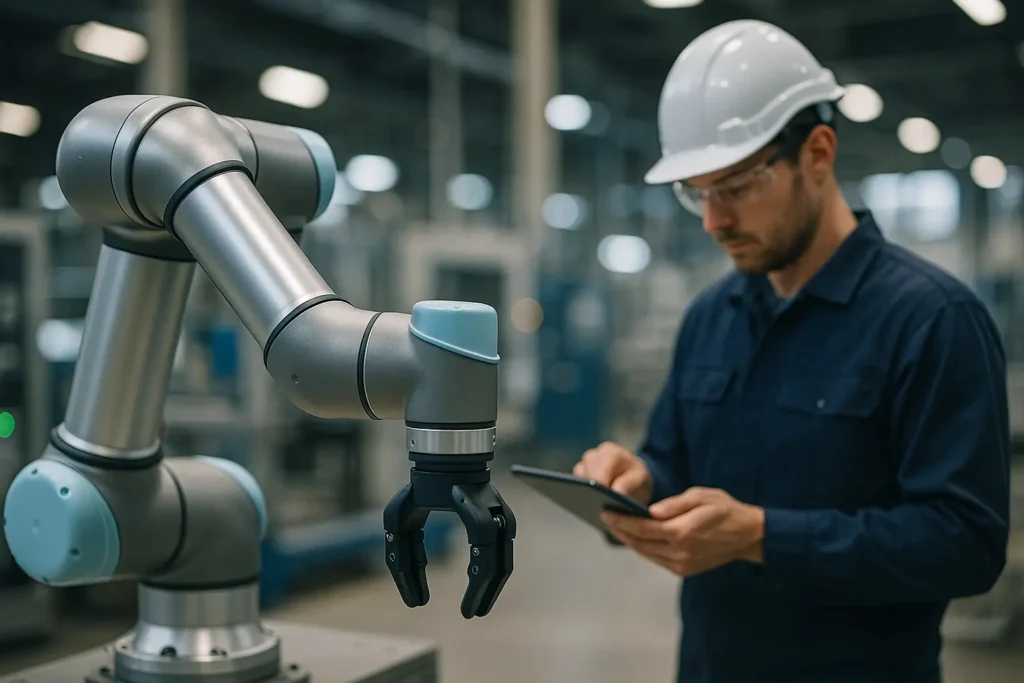
In February 2025 the International Organization for Standardization published the first full rewrite of its industrial robot safety standard since 2011. One of the more telling changes is a deletion. The revised ISO 10218 series no longer uses the words collaborative robot, and anyone selling a machine on that label now has to explain what they mean by it.
Key takeaways
- ISO 10218-1:2025 and ISO 10218-2:2025 were published in February 2025, the first revision since 2011.
- ISO/TS 15066 no longer stands alone; its contact limits sit inside ISO 10218-2.
- 64,542 cobots were installed worldwide in 2024, close to 12 percent of all industrial robots (IFR).
- Regulation (EU) 2023/1230 applies from 20 January 2027, with no transition period.
What a cobot is, and why the standard stopped saying it
The category exists because of a physical constraint. A conventional industrial robot moves fast, carries a heavy payload and cannot detect a person, so it is caged. A collaborative application removes the cage and replaces it with a set of controls: limited speed, limited force, and sensors that know where the operator is. The arm is usually lighter, rounder and slower than its caged equivalent, and it is normally programmed by demonstration rather than by code.
What the 2025 revision does is move the label from the hardware to the installation. The term collaborative robot has gone; the standards speak of collaborative applications instead. That is not linguistic tidiness. It closes a gap that integrators had been living with for a decade, where a machine certified as collaborative could be dropped into a layout that made it dangerous, and the paperwork still looked fine.
The four ways a robot is allowed to share a space
The ISO 10218 series has long described four techniques for organising that sharing, and a real installation often combines several of them across a single cycle.
- Safety rated monitored stop. The robot holds position with power on while a person is in the shared zone, and resumes when the zone clears. No motion happens while anyone is inside.
- Hand guiding. The operator moves the arm directly through a device with an enabling control, typically to teach a path or to position a heavy part.
- Speed and separation monitoring. Sensing keeps a protective distance; the robot slows as the operator approaches and stops before that distance is breached.
- Power and force limiting. Contact is permitted, provided the force, pressure or energy stays under defined biomechanical limits for the body part that could be touched.
Only the last of these allows a person and a moving robot to touch, and it is also the one that carries the most detailed numbers. Those numbers used to live in a separate technical specification, ISO/TS 15066, published in 2016. They now sit inside ISO 10218-2:2025, which distinguishes quasi-static contact, where a body part is clamped and cannot move away, from transient contact, where it can be pushed clear.
| Before the 2025 revision | After |
|---|---|
| ISO 10218-1 and -2, editions of 2011 | Third editions published February 2025 |
| Contact limits in a separate document, ISO/TS 15066:2016 | Absorbed into ISO 10218-2:2025 |
| One category of industrial robot | Class I for low hazard robots, Class II for the rest |
| The phrase collaborative robot in common use | Replaced by collaborative application |
The installed base is smaller than the coverage suggests
Cobots occupy a disproportionate share of the conversation relative to the share of the market they hold. On the International Federation of Robotics World Robotics 2025 report, covering 2024, 64,542 collaborative units were installed against a global total of roughly 542,000 industrial robots. That is close to 12 percent of annual installations, up from around 10.6 percent the year before. Real growth, and still a minority technology inside a worldwide operational stock of 4,664,000 robots.
The distribution matters more than the headline. Cobots concentrate where cycle times are moderate, part variety is high and volumes are too low to justify a dedicated fenced cell. Machine tending, small assembly, quality inspection, palletising light cases. Where takt time is the binding constraint, the caged robot still wins, and it wins on speed rather than on cost. Anyone weighing this against a broader automation plan will find the same trade-off running through our look at whether AI can replace factory floor workers.
What changes for a plant buying one in 2026
Two things, and both are about paperwork rather than hardware. The first is that the risk assessment now clearly attaches to the application. A supplier can hand over a conformity file for the arm, but the integrator still owes an assessment of the cell as installed, including the gripper, the workpiece and every edge an operator could be pushed against. Sharp tooling on a force limited arm has always been the failure mode that the label hides.
The second is European. Regulation (EU) 2023/1230 replaces the Machinery Directive 2006/42/EC and applies from 20 January 2027, with no transition period, meaning no declaration of conformity can be issued under it before that date and none can be issued under the old directive after it. The regulation brings software, cybersecurity and machine learning behaviour explicitly into scope, which is directly relevant to any cell where the robot adapts its path from sensor data. Buying a machine in 2026 that will still be running in 2030 is a good moment to ask a supplier which regime the file is written for.
The realistic framing for a cobot is neither the friendly co-worker of the marketing photography nor a threat to a headcount. It is a lower barrier to entry for automating a task nobody could previously justify automating, bought with a slower cycle time and a heavier obligation on whoever designs the cell.
One arm is not a strategy
A cobot solves a station. Deciding what the rest of the plant should look like is a different question, and a much older one.
Sources: ISO 10218-1:2025 and ISO 10218-2:2025, Robotics, Safety requirements, third editions published February 2025, superseding the 2011 editions and incorporating the content of ISO/TS 15066:2016 on power and force limiting, quasi-static and transient contact, and introducing Class I and Class II robot categories; International Federation of Robotics, World Robotics 2025 report released 25 September 2025, giving 542,000 industrial robots installed in 2024, an operational stock of 4,664,000 units, and 64,542 collaborative robot installations representing close to 12 percent of the annual total against about 10.6 percent in 2023; Regulation (EU) 2023/1230 of 14 June 2023 on machinery, in force from 20 July 2023 and applicable from 20 January 2027, replacing Directive 2006/42/EC. Standard clause numbers and limit values are not reproduced here; the published standards are the only authoritative text. Nothing in this article is a substitute for a risk assessment carried out on the actual installation. Updated August 2026.