
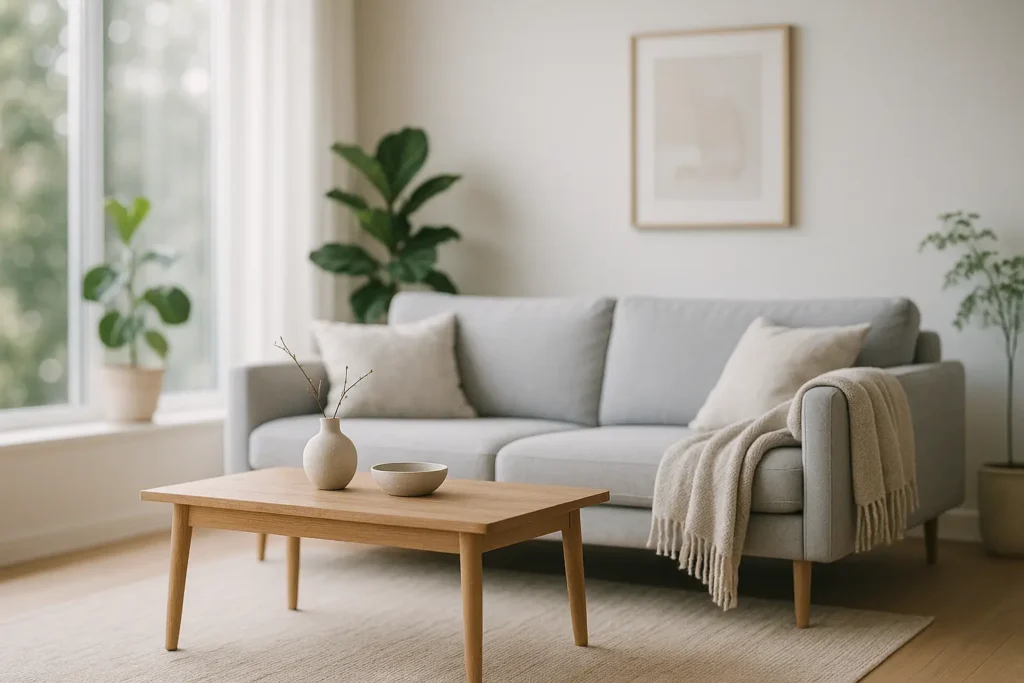
February 2026 came and went without the Stockholm Furniture Fair. The organisers cancelled the edition and moved the event to a biennial rhythm, with the relaunch set for 2027. If Scandinavian design were only a trend, the loss of its shop window would be the story. It isn’t, and that gap in the calendar is a decent excuse to look at what actually holds the thing together.
Key takeaways
- The label was coined abroad: “Design in Scandinavia” toured US and Canadian museums from 1954 to 1957 after opening at the Brooklyn Museum.
- The Lunning Prize, awarded to two Nordic designers a year from 1951 to 1970, built the movement’s reputation deliberately.
- Kaare Klint founded the Royal Danish Academy’s furniture school in 1924 and made students measure historic pieces before designing anything.
- Stockholm gets 6 hours 11 minutes of daylight at the solstice on 21 December 2026, which explains the obsession with light far better than any mood board.
The name was an export, and it was engineered
“Scandinavian design” was not a term the Nordic countries used about themselves first. It came out of North America, attached to a travelling exhibition. Design in Scandinavia opened at the Brooklyn Museum in 1954 and toured museums across the United States and Canada until 1957, carrying furniture, ceramics, textiles, silver and stainless steel from the five Nordic countries.
The reputational groundwork had started three years earlier. Frederik Lunning, who ran Georg Jensen’s New York operation, founded the Lunning Prize in 1951 and gave it to two Nordic designers every year until 1970. The stated intent was to fund young craftsmen and industrial designers through extended study abroad. In practice it created a roster of recognisable names and gave American buyers a reason to keep paying attention.
None of that makes the movement synthetic. It does mean the international profile was built on purpose, over two decades, by people who understood that a design culture needs an audience as much as it needs a workshop. Trends do not get twenty-year institutional scaffolding.
Klint’s homework: measure first, design second
The intellectual spine came earlier and from a classroom. In 1924 Kaare Klint co-founded the School of Furniture Design at the Royal Danish Academy of Fine Arts, the first formal programme of its kind in Denmark. His curriculum was unusual and slightly punishing: before drawing anything, students had to study historical furniture types through exhaustive measurement and analysis.
The logic was that good historic furniture already encodes generations of trial and error about how bodies sit, how plates stack, how books stand. You improve those solutions. You do not restart from an aesthetic impulse. Klint applied the same rigour to storage, sizing cabinets around the objects they were meant to hold rather than around a wall.
His students carried it out of the building. Børge Mogensen, Hans J. Wegner, Poul Kjærholm and Ole Wanscher all passed through, and the generation trained under Klint dominated Danish furniture through the 1950s and 1960s. The proportions people now read as “Scandinavian” are largely the residue of that measuring exercise.
Light is a constraint before it is a mood
The pale palette gets explained as calm. It is closer to arithmetic about daylight. Stockholm receives 6 hours and 11 minutes of daylight on the winter solstice, 21 December 2026. Further north, Tromsø sits in polar night from roughly 27 November to 15 January, and because mountains ring the city the practical dark season runs longer still, leaving a stretch of usable twilight from around 9am to 2pm.
Design under that constraint has to move light around rather than merely admit it. White and near-white surfaces work as reflectors. Low, generous window openings catch a sun that never climbs high. Layered artificial light is not decorative sequencing, it is the difference between a room being usable at three in the afternoon and not.
This is also the reason importing the aesthetic wholesale into a bright southern flat often falls flat. The same white walls that rescue a Helsinki January can read as glare in Andalusia. The principle travels. The specification does not.
How to tell the philosophy from the styling
Most of what is sold as Scandinavian is styling, and styling is not a crime. It is just a different purchase, with a different lifespan. The distinction is usually visible in under a minute if you know which question to ask.
| Styling cue | The principle it borrows from | Question that separates them |
|---|---|---|
| Pale oak veneer | Local, repairable timber chosen for a long service life | Can the surface be sanded and refinished, or is it 0.6mm of print? |
| All-white walls | Redistributing scarce daylight | Does the room actually lack light, or are you dimming a bright one? |
| Visible joinery | Construction honest enough to be inspected and repaired | Is the joint structural, or a moulded detail over dowels? |
| Slim, low seating | Dimensions derived from measured human use | Is it comfortable after two hours, or only in a photograph? |
| Sparse shelving | Storage sized to what you own | Where did the rest of your belongings go? |
That last row is the one people skip. Klint’s method starts from an inventory of what has to be housed. A room that looks minimal because its contents were shoved into a cupboard has adopted the photograph, not the philosophy.
Three objections worth taking seriously
“It is cold and impersonal”
Usually a symptom of copying the palette without the materials. The warmth in a Nordic interior comes from texture and tactility, wool, leather, untreated wood, sheepskin, against restrained colour. Strip out the textiles and you are left with a showroom. The restraint was never meant to carry the room alone.
“It is just minimalism with better PR”
The two overlap but start from opposite ends. Minimalism reduces towards an idea of visual purity. The Klint tradition reduces towards fitness for use, and will happily keep an ornate historical detail if it earns its place functionally. That is why a Wegner chair has curves a purist would have deleted. If you want the other side of that argument, we have looked at whether maximalism is the new minimalism.
“It has had its moment”
It has had several, and outlived all of them. The 1950s wave, the 1990s IKEA-driven revival, the hygge cycle of the mid 2010s. Each one exported a surface treatment and then exhausted it, while the underlying method stayed in the furniture schools, unbothered. The 2026 fair cancellation is a commercial event, not a verdict on the design culture behind it.
What survives, in the end, is not the palette. It is the habit of asking what an object is for before deciding what it should look like, which is a duller discipline than any trend forecast and considerably more durable.
Want the longevity question on its own terms?
Why some of these pieces are still in production seventy years after their launch is a separate, more commercial story.
Sources: Brooklyn Museum and encyclopedia.design records of the Design in Scandinavia touring exhibition, 1954 to 1957; Lunning Prize records, 1951 to 1970; Royal Danish Academy and Carl Hansen & Søn material on Kaare Klint and the School of Furniture Design founded in 1924; timeanddate.com solstice data for Stockholm, 21 December 2026; Visit Tromsø and Fjord Tours polar night dates; Dezeen and Stockholm Furniture Fair announcements on the cancellation of the 2026 edition and the move to a biennial format from 2027. Updated August 2026.