
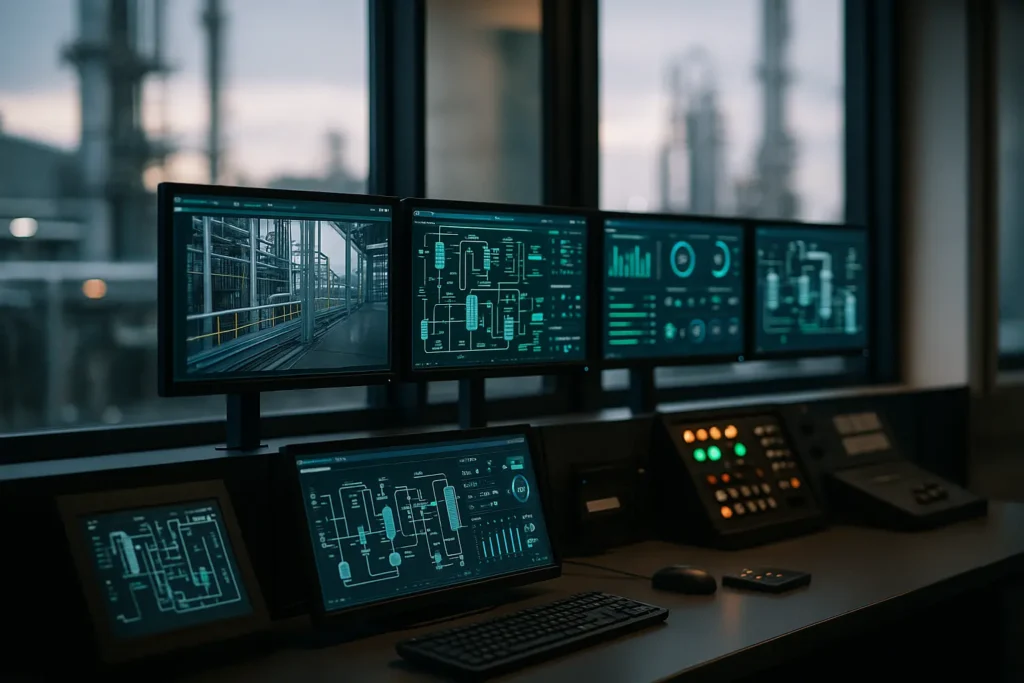
The phrase does a lot of work. A ghost factory sounds like an empty shed humming away in the dark, and a small number genuinely are. But the change that has actually spread across manufacturing is less cinematic and more consequential: the control room moved, and the shop floor stayed staffed.
Key takeaways
- FANUC’s Oshino site has robots building robots and is reported to run unattended for stretches of up to 30 days.
- Siemens Amberg is routinely miscast as a dark factory. It is lights-dimmed, with people on the floor and a stated quality rate of 99.9988%.
- Rio Tinto runs 18 Pilbara mines and a 2,000 km railway from an operations centre 1,500 km away in Perth.
- Dragos counted 119 ransomware groups hitting 3,300 industrial organisations in 2025, with manufacturing more than two-thirds of victims.
What counts as a ghost factory, and what mostly does not
A plant only earns the label if production continues through a full shift with nobody inside the building. By that test the list is short. The Institution of Mechanical Engineers, writing in April 2026, put it bluntly: unmanned plants remain “few and far between”, and a great many facilities marketed as dark are better described as lights-dimmed.
The genuine cases share a profile. Zeekr operates a robotic vehicle plant in northeast China with no human contact on the production line, at a stated 300,000 vehicles a year. Xiaomi’s Changping factory covers roughly 860,000 square feet across 11 automated lines and is reported to complete a smartphone every three seconds. FANUC, which has been at this since 2001, has robots assembling robots at Oshino with unattended runs reported to reach 30 days.
Notice what those three have in common. One product family, enormous volume, almost no variation between units. That is the narrow band where the fixturing, the vision systems and the material handling can be amortised. Siemens Amberg, the plant most often cited as proof that the model generalises, does not actually belong on the list. Its people work alongside the robots, and its widely quoted 99.9988% quality figure is a result of that arrangement, not of removing the humans.
The control room moved before the workforce did
Remote oversight scaled faster than unattended production because it solves a different problem: distance, not headcount. The clearest working example is not a factory at all. Rio Tinto directs its Pilbara iron ore system from an operations centre in Perth, about 1,500 km from the assets it controls.
The numbers give a sense of what is being steered from that room. The AutoHaul network connects 18 mines to the ports of Dampier and Cape Lambert across roughly 2,000 km of track. Up to 53 trains of 240 wagons run at Grade of Automation 4, meaning no driver on board, at headways as tight as 18 minutes, around the clock. Each train carries around 28,000 tonnes, and the railway moved 326.2 million tonnes in 2025.
That is the template travelling into manufacturing. The asset is instrumented, the decision layer is centralised, and the on-site role narrows to physical intervention. It reads as a smaller change than a dark factory. Operationally it is a larger one, because it decouples expertise from location.
| Site | What runs without people present | What people still do |
|---|---|---|
| FANUC, Oshino (Japan) | Robot assembly, reported unattended runs of up to 30 days | Scheduled maintenance, inspection, process design |
| Zeekr (northeast China) | Vehicle line with no human contact, stated 300,000 units a year | Validation, equipment repair, line changeover |
| Xiaomi Changping (China) | 11 automated lines, one handset reported every three seconds | New model introduction, tooling, quality escalation |
| Siemens Amberg (Germany) | Not unattended. Automated cells with staff present | Work alongside the automation, hence the 99.9988% figure |
| Rio Tinto Pilbara (Australia) | Driverless trains and haulage, supervised from Perth | Route planning and exception handling, 1,500 km away |
Why the economics stall on high-mix work
Automation intensity tracks product mix and labour structure far more closely than it tracks ambition. The International Federation of Robotics, publishing its 2024 density figures in April 2026, recorded 1,220 robots per 10,000 manufacturing employees in the Republic of Korea, 818 in Singapore, 449 in Germany, 446 in Japan and 307 in the United States, against a global average of 132.
The Chinese figure is the one worth pausing on. China installed 295,000 industrial robots in 2024, roughly 54% of the world total and the highest annual number on record, yet its density sits at 166, twenty-second globally. Volume of installation and depth of automation are simply not the same measurement, and a board that conflates them will approve the wrong project.
For a plant running dozens of variants in short batches, the case rarely closes. Every changeover demands either new fixturing or a vision stack flexible enough to cope, and the payback period stretches past the product’s own life. That constraint, rather than technology maturity, is why the unmanned list has stayed short for a quarter of a century.
The security bill that rarely reaches the business case
Removing people from a building removes the cheapest anomaly detector in the plant. Its replacement is a monitoring stack, and that stack is now a target. Dragos, in its ninth annual OT review published on 17 February 2026, tracked 119 ransomware groups affecting around 3,300 industrial organisations during 2025, up 49% from 80 groups the year before, with manufacturing accounting for more than two-thirds of victims.
Two figures from that report belong in any automation business case. Average ransomware dwell time in OT environments ran to 42 days, but organisations with genuine OT visibility contained incidents in an average of five. And 26% of the advisories Dragos reviewed shipped with no patch or mitigation available from the vendor, while 25% of ICS-CERT and NVD entries carried an incorrect severity score. Anyone budgeting for unattended operation is budgeting for that gap, whether or not it appears on the slide. We looked at the wider picture in our piece on how cybersecurity is evolving in the industrial world.
The questions that come up in every steering committee
Could our plant realistically run unattended?
Test it against product mix before anything else. If a single platform accounts for most of your volume and units barely vary, the question is a costing exercise. If you run short batches across many variants, the honest answer is that partial autonomy on selected cells is the achievable version, and pitching more than that tends to end badly.
What does remote oversight actually replace?
Supervision and diagnosis, not intervention. Centralised monitoring lets a small group watch many assets and decide what needs attention. Somebody still has to walk to the machine when a gripper fails. The saving comes from reallocating expert attention, not from emptying the site.
How many roles does a lights-out line remove?
We have not found a reliable public figure, and we would treat any confident number with suspicion. The plants named above publish output and quality metrics, not headcount deltas, and the roles that survive tend to be reshaped rather than simply subtracted. It is a genuine gap in the available evidence rather than a settled fact.
Where does the single point of failure sit?
Usually in the layer that coordinates everything: the supervisory system, the network carrying it, or the material handling that feeds every cell. IMechE makes the same point. In a plant with nobody inside, one stoppage halts the whole system, and the response clock starts when someone notices remotely rather than when someone hears it.
The label will keep circulating because it makes good copy. What we would take to a board is narrower and more useful: unattended production is a volume play with a short list of qualifying products, remote oversight is available to almost everyone, and both raise the cost of getting security wrong.
Wondering where that leaves the people on the floor?
The headcount question deserves a colder look than either the vendor pitch or the panic headline gives it.
Sources: Institution of Mechanical Engineers, “Inside the rise of unmanned dark factories”, 9 April 2026 (Zeekr, Xiaomi Changping, FANUC Oshino and Siemens Amberg figures); International Federation of Robotics, World Robotics 2025, density release of 8 April 2026 covering 2024 data; Rio Tinto operational disclosures on AutoHaul and Pilbara shipments for 2025; Dragos OT Cybersecurity Year in Review, published 17 February 2026, covering 2025. Plant-level output and quality figures are reported by the operators themselves and have not been independently audited. Updated August 2026.