Most small-apartment advice assumes you own the place. Ours does not. Everything below survives a rental inspection, comes off the wall with a screwdriver or a plastic tab, and is ordered by what it costs, from nothing at all to the one purchase we think is worth saving for.
Key takeaways
- Visible floor, not clever storage, is what reads as space.
- One bulb colour temperature throughout costs almost nothing and fixes a lot.
- Curtains hung to the ceiling change perceived height instantly.
- Keep every original fitting you remove, in a labelled bag, until you move out.
What a small apartment actually is, in numbers
Worth knowing what you are working with. RentCafe’s national apartment size report, published on 10 August 2026 and based on Yardi Matrix data for units completed between 2016 and 2025, puts the average new American apartment at 910 square feet. Broken down, that is around 460 square feet for a studio, 735 for a one-bedroom and 1,095 for a two-bedroom. A studio, in other words, is roughly one decent-sized room plus a bathroom, and every decision has to earn its floor area.
Two ground rules before spending anything. Measure the room and draw it flat before you buy furniture, because almost every small-space mistake is a piece bought thirty centimetres too deep. And check your tenancy agreement on drilling, adhesives and repainting, then keep the original handles, blinds and light fittings in a labelled bag so the flat can go back exactly as you found it.
The ten, cheapest first
1. Clear the floor before you buy anything
The eye reads uninterrupted floor as space, which is why a room can hold more furniture and still feel bigger once the boxes, drying racks and stacked storage crates are gone. Do this first, live with it for a week, then decide what you actually need. A fair number of planned purchases quietly disappear at this stage.
2. Put the tall stuff on the wall you look at least
Every room has a wall you face and a wall behind you. Wardrobes, shelving towers and anything above chest height belong on the second one, so the sightline from the door stays low and long. Costs nothing but an afternoon and a friend.
3. Choose furniture with visible legs
A sofa or sideboard raised on legs lets the floor run underneath it, and that continuous floor plane is a large part of why the same square footage feels different. When you cannot replace a plinth-based piece, adding screw-in legs to a flat-pack unit costs very little and has the same effect.
4. Standardise every bulb in the flat
Mismatched colour temperature is the single most common reason a cheap rental reads as cheap. One warm range, roughly 2700 kelvin, in every fitting including the kitchen, and the room stops looking patched together. A pack of bulbs is the least expensive meaningful change on this list.
5. Replace the single overhead with two low lamps
A ceiling light on its own flattens a room and pushes the corners into shadow. Two lamps at roughly seated eye height, one at each end of the space, create the pools of light that make a small room feel occupied rather than institutional. If your tenancy allows nothing else, a plug-in dimmer on one of them is the cheapest upgrade left.
6. Hang curtains high and wide
Fix the track close to the ceiling rather than to the top of the window, and extend it far enough past each side that the open curtains sit against the wall rather than over the glass. The window looks larger, the wall looks taller, and none of the daylight is lost. In a rental this is usually two screw holes to fill on the way out.
7. Use the band above door height
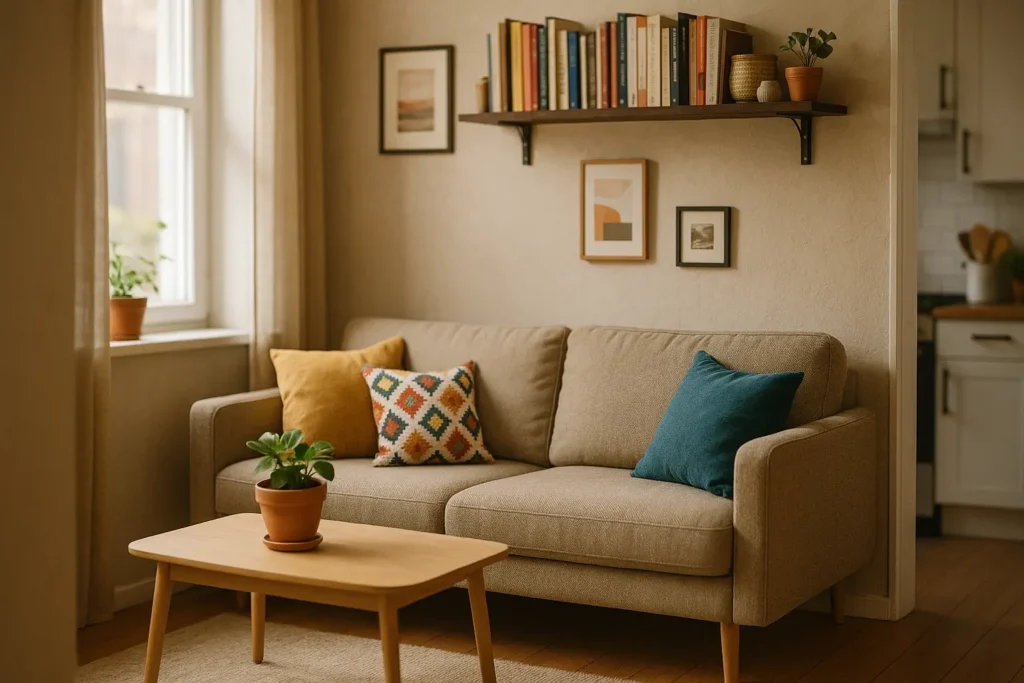
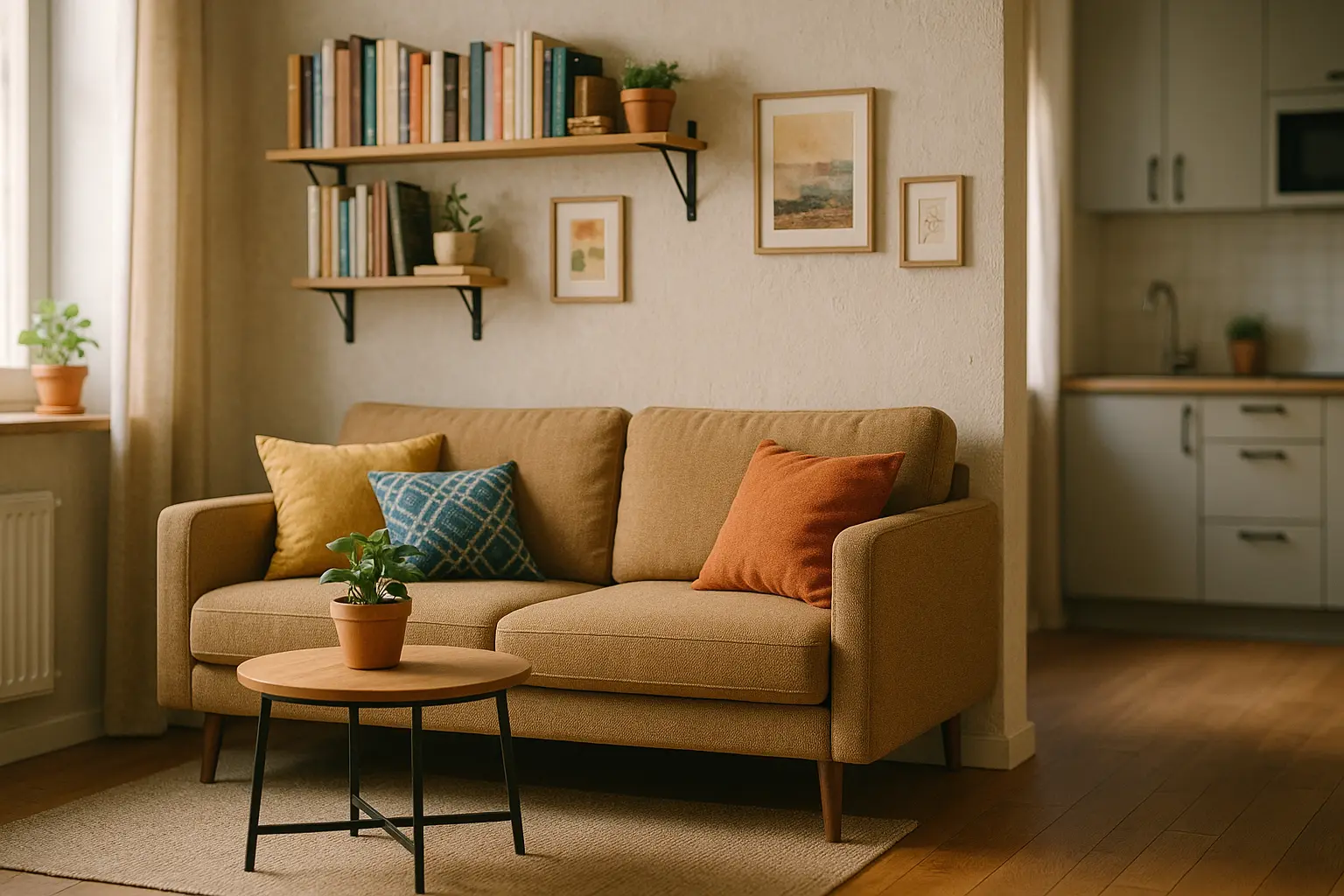
The strip of wall between the top of a door and the ceiling is dead space in almost every apartment. A shelf run at that level holds books, files and the things you use monthly rather than daily, and because it sits above the sightline it does not crowd the room. Wall-mounted shelving above a sofa, as in the room above, buys storage without touching the floor plan.
8. One rug, sized properly
The common mistake is buying too small. A rug that floats in the middle of the floor with everything standing off it chops the room into pieces. Go large enough that at least the front legs of the seating sit on it, and the whole zone reads as one thing. This is also, as it happens, the biggest acoustic improvement available in a hard-floored flat.
9. Place a mirror for what it reflects, not for size
A mirror does not add light by existing. It doubles whatever is in front of it, so a large one facing a window or an open doorway gives you back daylight and depth, while the same mirror facing a blank wall gives you back a blank wall. Lean it rather than hang it if drilling is a problem.
10. Swap the handles
Kitchen and wardrobe hardware is the detail that dates a rental fastest, and it is the easiest thing to change reversibly. Replace the knobs and pulls, keep the originals in that labelled bag, and the units read as several years newer for the cost of a takeaway. Match the metal to the door hinges rather than to the taps if you cannot match everything.
What comes off the wall, and what does not
If you rent, sort every idea into these three buckets before you start, and check the tenancy wording rather than assuming.
| Change | Leaves a mark? | Worth clearing with the landlord |
|---|---|---|
| Bulbs, lamps, plug-in dimmer | No | No |
| Handles and knobs | No, if originals are kept | No |
| Curtain track, wall shelves | Fixing holes to fill | Usually yes |
| Peel-and-stick film or paper | Sometimes, on aged paint | Yes, and test a hidden patch |
| Repainting a wall | Yes | Always, in writing |
Where we would spend, if there is money for one thing
The rug. It is the only item on this list that changes how the room looks, how it sounds and how it feels underfoot at the same time, and a good one moves with you to the next flat. Everything else here is either free or genuinely cheap, which is the whole point of doing them in this order. For the layout side of the problem, our piece on designing small spaces without feeling cramped goes further into circulation and zoning than we can here.
Questions we get from renters
Do light colours really make a small room look bigger?
They reflect more light, which softens the boundaries between wall and ceiling and makes the edges of the room harder to place. That is a real effect, but it is smaller than the effect of clearing the floor, and a dark room that is well lit often feels better than a pale one that is not.
Is multi-functional furniture worth it?
Only when the second function is one you will genuinely use daily. A sofa bed for nightly sleeping earns its place. A coffee table that converts to a desk you will use twice a year is a compromise on both counts.
How do I add storage without the flat feeling full?
Keep new storage either above door height or below seat height, and leave the middle band, which is where your eye rests, as clear as you can manage.
What is the most common mistake in a studio?
Buying furniture that is too deep. A sofa at 95 centimetres deep instead of 80 costs you a walkway, and no styling recovers that.
Run the free ones this weekend and the cheap ones next month. If the flat still feels tight after that, it is a layout problem rather than a decorating one, and no amount of baskets will fix it.
Not everything visible has to be tidied away
There is a version of clutter that works on purpose, and small flats benefit from it more than large ones.
Sources: RentCafe national apartment size report, published 10 August 2026, based on Yardi Matrix data as of May 2026 for units completed 2016 to 2025. Tenancy rules on drilling, adhesives and redecoration vary by contract and jurisdiction: check your own agreement before making fixed changes. Updated August 2026.