
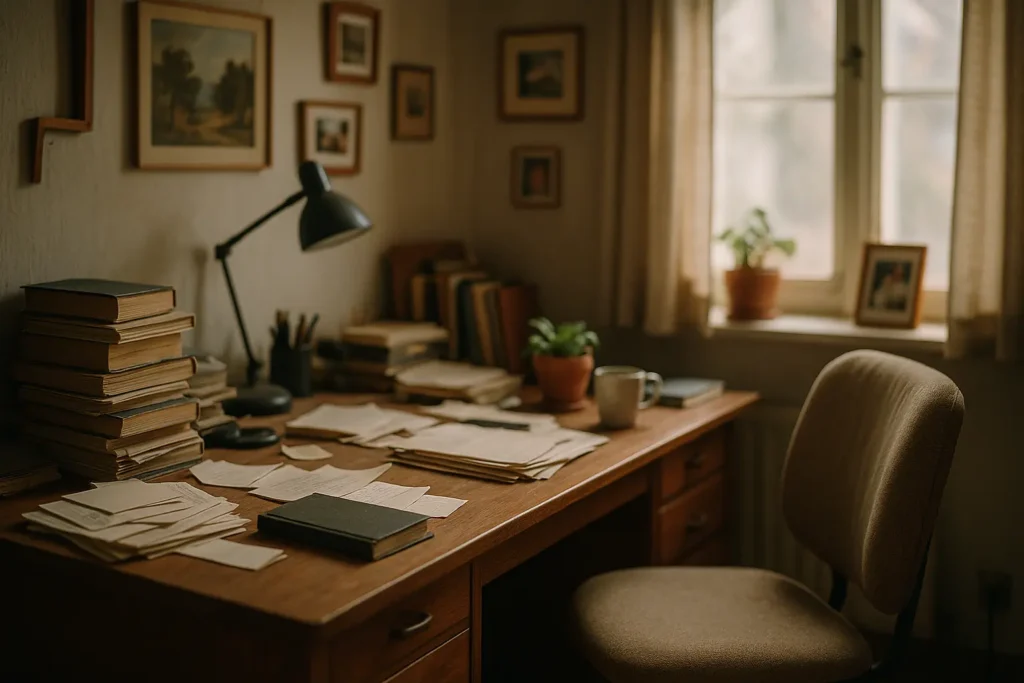
Every few seasons a phrase arrives that quietly lets everyone off the hook. This year it is functional clutter, and we keep watching it get attached to rooms where the real story is a coffee table nobody can put a cup on. The idea underneath the phrase is sound. The label is carrying more weight than it has earned, which seems worth untangling before another January of trend decks makes it permanent.
Key takeaways
- Princeton work published in 2011 found that competing objects in the visual field mutually suppress each other in the visual cortex.
- A UCLA study of 60 dual-income spouses tied “messy home” language to flatter daily cortisol slopes in wives.
- Intentional density holds up when objects are grouped, contained, and edited on a fixed schedule.
- Trend forecasts for 2026 point to curated maximalism rather than an invitation to stop tidying.
What the research actually says about visible mess
The evidence base is smaller and more cautious than the wellness industry suggests, but it points in one direction. In January 2011, researchers at the Princeton Neuroscience Institute published work in the Journal of Neuroscience showing that multiple stimuli present in the visual field at the same time compete for neural representation, mutually suppressing the activity each would evoke alone. That competition can be counteracted by deliberate attention. The catch is that deliberate attention is finite, and spending it on a bookshelf is spending it.
On the emotional side, Darby Saxbe and Rena Repetti analysed home tours recorded by 60 dual-income spouses as part of UCLA’s Center on Everyday Lives of Families, published in 2010. Wives whose language leaned on words like mess and chaotic showed flatter diurnal cortisol slopes over the following weekdays, a profile associated with poorer health outcomes, and a more depressed mood across the day. Wives who described their homes in restorative terms showed the opposite pattern. Husbands showed no comparable effect, which is itself a finding worth sitting with.
Later work keeps pointing the same way. Roster, Ferrari and Jurkat, writing in the Journal of Environmental Psychology in 2016, found that possession clutter had a strong negative effect on both a person’s psychological sense of home and their perceived wellbeing. A 2025 paper in the same journal, examining perceived home beauty as a mediator, again reported lower wellbeing and life satisfaction among people who saw their own homes as cluttered. All of it is self-report and correlational, and none of it was designed to test whether forty ceramic pieces composed on one shelf read differently to the brain than forty unrelated items across a worktop. That gap is exactly where the interesting question lives.
Four questions that separate density from mess
What separates the two is not quantity. It is whether the arrangement survives being asked about. We use four questions, in order, and an object that fails any of them goes into a drawer rather than onto a shelf.
- Have you touched it in the last month, or can you tell its story in one sentence? Use or meaning. One or the other is enough. Neither is not.
- Is it part of a group, or is it alone? Objects gathered by colour, material or height read as a collection. The same objects scattered across three surfaces read as residue.
- Does it have an edge? A tray, a shelf lip, a bowl, a defined run of wall. Density inside a boundary looks composed. Density without one looks like it is spreading.
- Is there anything left empty nearby? A full room with one clear surface reads as a choice. A full room with no clear surface reads as a condition.
Room by room, where intentional density earns its place
The living room: group rather than scatter
This is the room where the approach genuinely works, because a living room is where the objects that explain a household already live. The move that matters is consolidation. Travel pieces on one shelf run, books stacked horizontally to make a plinth rather than lined up in a thin row, frames hung as a block with consistent spacing instead of drifting across a wall. Mixed texture does a lot of the work here, and it costs nothing: one woven, one ceramic, one metal, one paper, within the same group.
The kitchen: only what your hands find weekly
Open shelving and hanging racks are where good intentions go to collect grease. The filter we would apply is contact frequency rather than beauty. A pan used twice a week has earned the wall. A copper pot bought for the photograph has not, and within a year it will read as neither functional nor clean. Spices, oils and the three knives actually in rotation are the strongest candidates for permanent display, because their use rate keeps them moving and therefore keeps them dust-free.
The bedroom: the room to deliberately under-fill
If any room argues against the trend, it is this one. The cortisol findings above relate to how a home is perceived overall, and a bedroom is usually the last space someone looks at before sleeping. We would keep the density high in the living areas and let the bedroom hold three or four objects on a bedside surface at most. A book in progress, a lamp, one plant, one photograph. That is not minimalism as an ideology. It is a room doing a narrower job.
Storage is the part nobody photographs
Every version of this look that survives a few years is propped up by closed storage doing invisible work behind it. The visible portion only reads as composed because the rest is out of sight. Practically, that means ottomans and benches with hollow bases, deep drawers under beds, and a run of closed cabinetry below the open shelving. It also means accepting a rhythm: curated density is a standing edit, not a one-off arrangement. Anything on display that has not been touched or mentioned since the last pass has quietly become clutter, however good it looked when it arrived.
Why the phrase caught on in 2026
The vocabulary shift is real, and it is commercial. Pinterest’s 2026 forecast named home trends including FunHaus, Afrohemian Decor, Neo Deco and Extra Celestial, all of them explicit rejections of neutral minimalism. IKEA has been promoting a maximalist reinterpretation it calls joycore for spring 2026, built on bold colour and playful pattern. These are trend forecasts published by companies that sell things, and they should be read as such, but the direction of travel is not in doubt after a decade of beige.
What almost every serious forecast adds, and what gets lost in the shorthand, is the word curated. The 2026 version of more is not permission for more of everything. If you want the fuller argument on where that line sits, we picked it apart in our piece on whether maximalism is the new minimalism.
What we would not do
- Treat the label as a diagnosis. Calling an existing pile intentional after the fact is the one move that guarantees the room never improves.
- Display anything that needs explaining twice. If the story takes a paragraph, it belongs in a book, not on a shelf.
- Let paperwork into the composition. Post, chargers and receipts never read as curated, in any style, in any room.
- Apply it to a rented flat you are leaving. Density is expensive to move and rarely survives the reassembly.
Is functional clutter just an excuse for being untidy? It can be, and often is. The distinction is testable: intentional density survives being asked why each object is out, and mess does not.
Does it work in a small flat? It works in one zone of a small flat, not across it. In tight square footage the visual competition described in the Princeton research bites harder, so we would concentrate density on a single wall and keep circulation routes clear.
Can it coexist with a minimalist scheme? Yes, and that is usually the strongest version. A restrained shell with one dense, deliberate area reads as confidence. Density everywhere reads as a house that never got finished.
How often should the arrangement be edited? Twice a year is a workable rhythm for most homes, with a faster pass in the kitchen where use patterns change with the seasons.
The honest summary is that mess and intentional density are not two points on the same scale. One is a failure to decide, and the other is a decision made visible. The rooms that pull this off are not the ones with the most objects. They are the ones where somebody could walk you around and account for all of it.
Interested in what a room is doing to you rather than for you?
The same evidence base sits underneath a much broader question about how interiors are chosen.
Sources: McMains and Kastner, “Interactions of Top-Down and Bottom-Up Mechanisms in Human Visual Cortex”, Journal of Neuroscience, January 2011; Saxbe and Repetti, “No Place Like Home: Home Tours Correlate With Daily Patterns of Mood and Cortisol”, Personality and Social Psychology Bulletin, 2010, UCLA Center on Everyday Lives of Families; Roster, Ferrari and Jurkat, Journal of Environmental Psychology, 2016; Journal of Environmental Psychology, 2025, on home clutter, perceived home beauty and wellbeing; Pinterest Predicts 2026 and IKEA spring 2026 trend communications. Clutter research cited here is self-reported and correlational, and trend forecasts are commercial documents. Updated August 2026.