Almost every rug that disappoints was bought one size too small. Colour can be lived with, pattern grows on people, a fibre that turned out to be the wrong choice can be replaced in five years. A rug that floats in the middle of the floor like a bath mat is wrong on day one and stays wrong, because the fault is not in the object but in the arithmetic that preceded it.
Key takeaways
- Under a dining table, allow about 60 cm of rug beyond every edge so chairs stay on it.
- Wool has a limiting oxygen index of roughly 25, above the 21% oxygen of ordinary air.
- A thick rug over underlay lifts noise reduction to around 0.35 to 0.55 NRC.
- US rugs under 24 square feet fall under a separate flammability standard, FF 2-70.
Size is the only decision you cannot walk back
Work from what the rug has to reach, not from the dimensions of the room. Three conventions cover most situations, and they exist because of how bodies and chairs move rather than because of fashion.
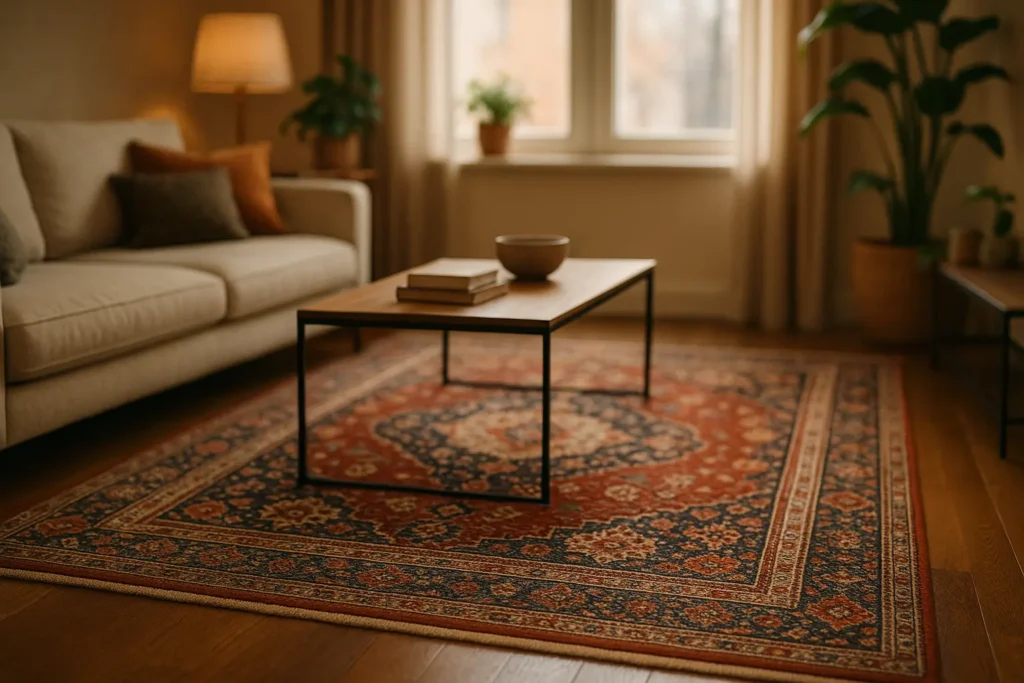
- Seating areas. The front legs of every seat in the arrangement should stand on the rug. Anything less and the rug reads as an island the furniture is floating past. Anything more, meaning all legs on, is generous and expensive but the most settled-looking option in a large room.
- Dining rooms. Allow roughly 60 cm, or 24 inches, beyond each edge of the table. That is the distance a chair travels when someone stands up, and it is the whole reason the convention exists: a back leg dropping off the edge mid-meal is the fastest way to hate a rug.
- Bedrooms. Run the rug under the bed, starting level with the bedside tables or just below them, and let it come out 45 to 60 cm at the sides and foot. What you are buying is the surface your feet land on, so the sides matter more than the top.
The familiar advice to leave about 45 cm of bare floor around the perimeter is a good default in a generous room and terrible in a small one, where a border that wide simply makes the room look smaller. In a compact space, size up and let the rug run closer to the skirting.
Fibre is a decision about ageing, not about feel in the shop
Everything feels pleasant under a hand in a showroom. What separates the fibres is how they behave after three winters of the same footfall, and there is one property worth knowing before the sales conversation starts. Wool has a limiting oxygen index of about 25, according to wool industry testing data, meaning it needs an atmosphere of at least 25% oxygen to keep burning while ordinary air holds around 21%. It chars and self-extinguishes rather than melting, which is why it has been the default in front of open fires for centuries.
| Fibre | Where it earns its price | Where it will let you down |
|---|---|---|
| Wool | Living rooms, hallways, anywhere with a fireplace; recovers from crushing | Sheds for months when new, and dislikes prolonged damp |
| Nylon | Stairs and family rooms; the most abrasion-resistant common pile fibre | Can look flat and slightly plastic in raking daylight |
| Polypropylene | Outdoors, kitchens, under high chairs; shrugs off bleach and rain | Crushes permanently under heavy furniture and holds oily marks |
| Viscose, sold as art silk | Sheen at a fraction of silk’s cost, in low-traffic bedrooms only | Water marks it permanently, including from a damp cloth |
| Jute and sisal | Texture and layering, at the lowest price per square metre | Rough underfoot, and stains that cannot be washed out |
If a room takes food, animals or children, that column on the right should decide the purchase. Viscose in a dining room is the single most regretted rug we come across.
Two labels worth reading before you pay
Rugs carry more regulation than most buyers realise, and two labels tell you something a description never will.
The first is flammability. In the United States, small carpets and rugs, defined as those with no dimension over 6 feet and an area under 24 square feet, fall under 16 CFR Part 1631, the FF 2-70 standard, while larger carpets sit under FF 1-70. A small rug that fails the test can still be sold, but it must carry a permanent label reading “FLAMMABLE (FAILS U.S. DEPARTMENT OF COMMERCE STANDARD FF 2-70): SHOULD NOT BE USED NEAR SOURCES OF IGNITION”, and rugs treated with a fire retardant must be marked with the letter T. That label is not decoration.
The second is indoor air. The Carpet and Rug Institute’s Green Label Plus programme tests for volatile organic compound emissions over a 14-day chamber period under California’s Section 01350 protocol, with limits set at half the chronic reference exposure level for 13 compounds in carpet. Green Label began in 1992 and Green Label Plus raised the bar in the 2000s. If a new rug is going into a bedroom or a child’s room, it is the certification worth asking about.
Nobody buys a rug for the acoustics, then cannot live without them
The change most people notice within a week has nothing to do with looks. A hard floor reflects speech and footfall; textiles absorb them. Data from the Carpet and Rug Institute puts standard cut-pile carpet at a noise reduction coefficient of about 0.25, while a thick rug laid over an underlay reaches roughly 0.35 to 0.55. NRC runs from 0 to 1 and averages absorption across the speech frequencies, so those are meaningful jumps in a room with wood or tile underfoot.
Which is the practical argument for the underlay that most people skip. It buys acoustic performance, stops the rug creeping, spreads the load so the pile crushes more slowly, and removes a genuine slip hazard on a smooth floor. It is the cheapest part of the purchase and the one that changes the rug most.
Who made it, and why the question is not sentimental
Handmade rugs come from supply chains that are hard to see from a showroom. GoodWeave certification exists for exactly that reason: it licenses its label to companies that submit to unannounced inspections against standards prohibiting child, forced and bonded labour. By its own account the label now covers around 9% of the global handmade rug market, and sales under the system have supported education for more than 44,000 children.
Nine percent is a small share, which is the honest reading of it. It also means the certification is a real filter rather than a box everyone ticks, and asking for it is a reasonable thing to do on a purchase in the hundreds or thousands.
Colour and pattern come last, and that is not a demotion
By the time size, fibre and underlay are settled, the palette question has usually answered itself. A busy room wants a quiet rug; a spare room can carry a loud one. The more useful move is to think in texture rather than colour, because a flat weave and a high pile in the same shade produce completely different rooms, a point we made at greater length in our piece on why texture is the real game-changer in decor.
One practical test that costs nothing: photograph the room, desaturate the image on your phone, and look at where the dark and light masses sit. If the floor is the lightest thing in a grayscale photograph, a pale rug will make the furniture look like it is hovering.
Five mistakes we keep seeing
- Measuring the room instead of the furniture. The rug relates to the seating group, not the walls.
- Skipping the underlay. It is 5% of the budget and the largest single influence on how the rug feels and lasts.
- Putting viscose where liquid goes. One spilled glass of water leaves a permanent halo.
- Buying pattern to hide traffic. Pattern hides crumbs, not crushing; only fibre choice addresses wear.
- Never rotating it. A half-turn twice a year evens out both footfall and sun bleaching, and costs nothing.
None of that requires a designer. It requires a tape measure, an honest description of what happens on that floor in a normal week, and the discipline to settle the size before falling in love with a pattern.
Working with less floor than you would like?
Rug sizing behaves differently once the room stops being generous, and so does everything around it.
Sources: US Consumer Product Safety Commission, 16 CFR Part 1631, Standard for the Surface Flammability of Small Carpets and Rugs (FF 2-70), covering rugs with no dimension over 6 feet and an area under 24 square feet, including the wording of the required flammability label and the T marking for fire-retardant treatment; larger carpets fall under 16 CFR Part 1630 (FF 1-70). Carpet and Rug Institute, Green Label Plus programme, 14-day chamber testing under California Section 01350 with limits at half the chronic reference exposure level for 13 compounds in carpet, testing carried out by UL Solutions; Green Label launched 1992. Carpet and Rug Institute data on noise reduction coefficients, approximately 0.25 for standard cut-pile carpet and 0.35 to 0.55 for a thick rug over underlay. Wool industry testing data reported by Woolmark for a limiting oxygen index of around 25 against roughly 21% oxygen in air. GoodWeave International for the figure of around 9% of the global handmade rug market certified and education supported for more than 44,000 children, both self-reported by the organisation. Sizing distances are long-standing trade conventions rather than standards. Updated August 2026.