Start with the fact that tends to end the conversation. As Paul S. Atkins, professor of Japanese at the University of Washington, has pointed out, wabi-sabi does not appear in standard dictionaries of the Japanese language. The pairing took hold internationally around 1980 and was then reimported into Japan as a foreign idea. That does not make it worthless. It does mean anyone selling you a wabi-sabi sideboard is selling a Western concept with a Japanese name on it.
Key takeaways
- The compound term is absent from standard Japanese dictionaries.
- Leonard Koren’s 1994 book introduced it to a non-Japanese readership.
- Sen no Rikyu’s contributions were concrete: raku ware, bamboo, a crawl-through door.
- The practical translation is patina, shadow and subtraction, not a shopping list.
Two words, two traditions
Wabi belongs to tea
Wabi descends from the classical verb wabu, meaning to languish or to be miserable, and its original register is closer to poverty than to serenity. Its transformation into an aesthetic ideal happened through tea practice across the fifteenth and sixteenth centuries, where the deliberately modest utensil and the small, plain room were set against the imported Chinese luxury that dominated elite taste. Wabi is a value judgement made in public, and it only means anything against the expensive alternative it refuses.
Sabi belongs to poetry
Sabi comes from a different root, sabu, carrying associations of rust, age and decay, and emerged as an aesthetic ideal in seventeenth-century poetry. Atkins draws a distinction worth keeping: the loneliness in sabi is not the grief of a person who has lost someone, it is the impersonal, contemplative solitude found in a landscape. Sabi is what age does to a surface and to a mood, without anyone deciding it should.
Held apart, the two ideas are useful in a room. Wabi is a decision about what you refuse to buy. Sabi is what happens afterwards, without your help.
How the compound reached the design press
The single book most responsible for the English-language version is Leonard Koren’s Wabi-Sabi for Artists, Designers, Poets and Philosophers, published by Stone Bridge Press in 1994. It framed the pairing as a beauty of things imperfect, impermanent and incomplete, and effectively every subsequent title with wabi or wabi-sabi on the cover descends from it.
The result is a genuine idea with an invented lineage. What Western design writing calls wabi-sabi is a real preference for the worn and the unfinished, assembled recently, using older Japanese terms as its vocabulary. Knowing that is not pedantry, it is what stops the whole thing collapsing into a style you can order in one delivery.
What Rikyu actually changed
Sen no Rikyu, the sixteenth-century tea master usually invoked in these discussions, is more interesting as an editor than as a philosopher. His innovations were specific and are still in use: the bamboo tea scoop in place of an ivory or metal one, black raku ceramics made by hand rather than thrown on a wheel, and the nijiriguchi, an entrance so low that guests had to crawl into the tearoom and could not carry a sword through it.
Each of those is a constraint imposed on a luxury practice, not an ornament added to a plain one. That is the transferable part. The move is always removal, and it costs something, which is precisely why it reads as a decision rather than as decoration.
Kintsugi, and a story that may not be true
The most-repeated origin story holds that the shogun Ashikaga Yoshimasa, who lived from 1436 to 1490, sent a broken Chinese tea bowl to China for repair, was appalled to receive it back stapled with metal, and set Japanese craftsmen looking for something better. The result, lacquer joins dusted with gold, became closely associated with tea ceramics through the sixteenth century.
It is a good story, and there is little documentary evidence that this particular episode happened. Treat it the way you would any founding anecdote: the technique and its meaning are real, the origin is folklore. What is genuinely useful is the underlying stance, which is that a repair is allowed to be visible. Applied to a home this is not about gold lacquer, it is about keeping the chipped bowl in circulation and letting the mended chair leg show its glue line.
What it looks like in a room people actually live in
Three things carry over, and none of them requires buying anything Japanese.
Materials that record time. Oiled or unfinished timber, lime plaster, unglazed stoneware, undyed linen, raw brass. What these share is that they document use instead of resisting it, which is the opposite of a lacquered surface designed to look identical for a decade. A room built from them looks better in year five than in year one, and it means accepting that the first scratch is not a failure. We looked at the wider version of this argument in our piece on materials that tell a story, from clay walls to smart glass.
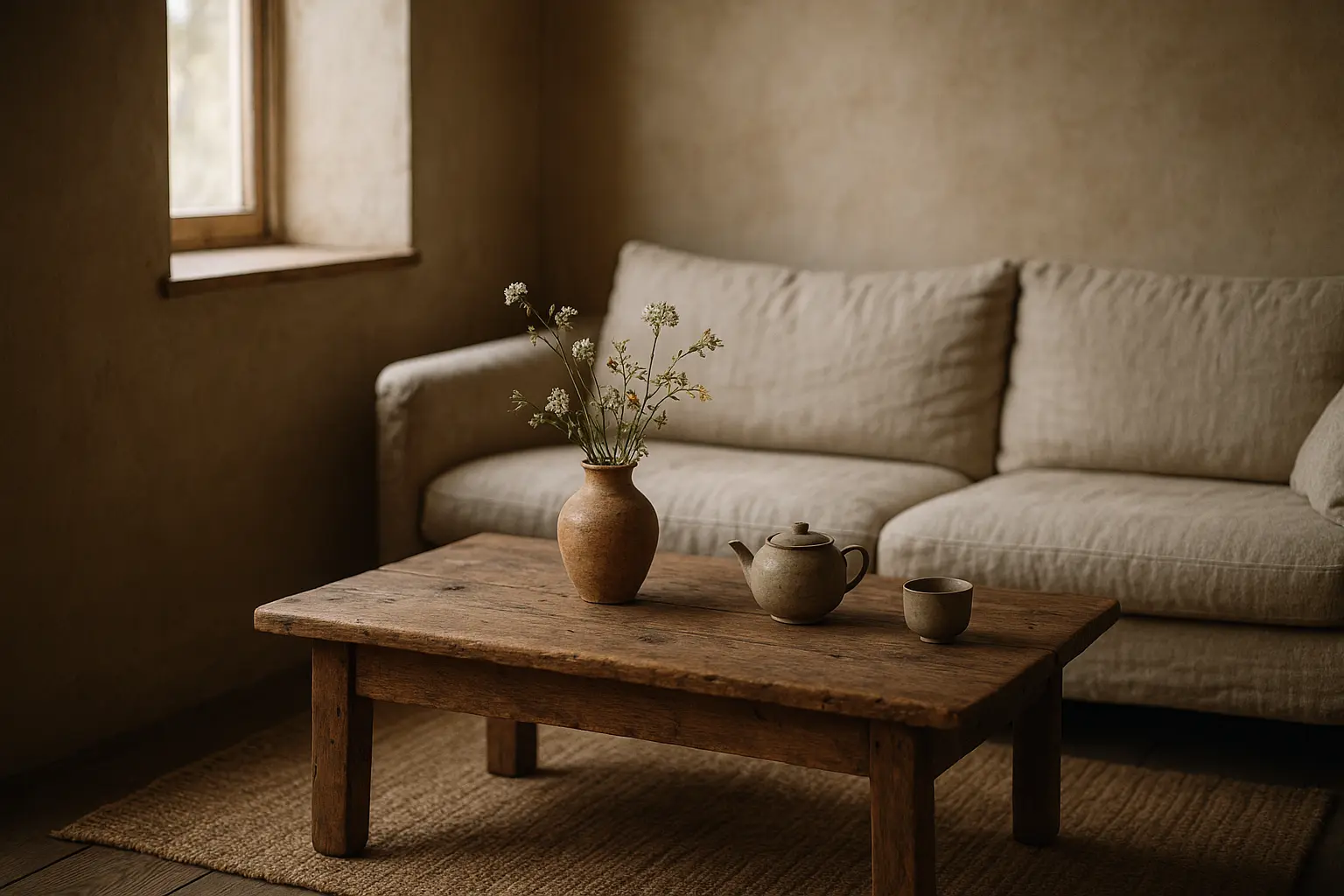
Light kept low and uneven. The best argument for this was made by Junichiro Tanizaki in In’ei Raisan, published in two issues of the magazine Keizai Orai in December 1933 and January 1934 and known in English as In Praise of Shadows. His point was that Japanese objects, gold leaf, lacquer, dull ceramic glazes, were designed for dim, uneven interiors and look crude under bright even light. Practically, that means fewer light sources at lower levels rather than a bright ceiling fitting, and it costs nothing to test tonight.
Fewer objects, none of them decorative only. The tea room logic is that everything present is used. A shelf with three things on it that all get picked up beats a shelf styled with nine that never move. This is the hardest part, because it is the only one you cannot buy your way into.
What it is not
It is not minimalism. Minimalism reduces form towards a designed ideal and dislikes irregularity; the wabi tradition tolerates rough, asymmetrical and visibly handmade things that a strict minimalist would reject as noise.
It is not shabbiness, either. A cracked glaze on a bowl that is still in daily use is not the same as a broken thing kept out of inertia, and the difference is whether the object still does its job. Nor is it a colour scheme. The beige and grey palette that travels under this name in furniture catalogues is a photographic convention, not a principle, and there is nothing in either term that rules out colour.
The version of this worth having at home is unromantic and slightly inconvenient. Buy less, buy things that age, mend them in the open, and turn the lights down. Everything else is a label.
Not everything tidy is better
There is a case for the mess that stays, provided it is the kind that earns its place.
Sources: Paul S. Atkins, professor of Japanese at the University of Washington, writing in The Conversation, for the separate etymologies of wabi (from wabu, to languish) and sabi (from sabu, associated with rust and age), the emergence of sabi as a poetic ideal in the seventeenth century, the absence of the compound from standard Japanese dictionaries, its international popularisation around 1980 and subsequent reimport into Japan, and Sen no Rikyu’s innovations including bamboo scoops, black raku ware and the low tearoom entrance. Leonard Koren, Wabi-Sabi for Artists, Designers, Poets and Philosophers, Stone Bridge Press, 1994. Junichiro Tanizaki, In’ei Raisan, published in two issues of Keizai Orai in December 1933 and January 1934; complete English translation as In Praise of Shadows, 1977. The Ashikaga Yoshimasa origin story for kintsugi is widely repeated but poorly evidenced and is presented here as tradition rather than established fact; Yoshimasa’s dates are 1436 to 1490. Updated August 2026.