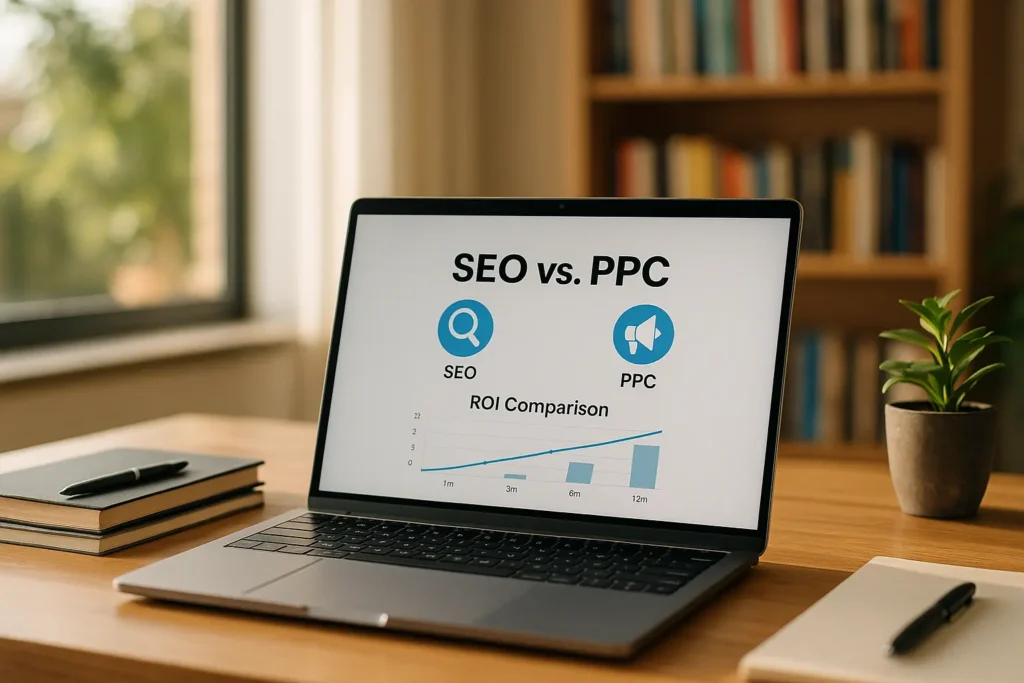
Google publishes the sentence that settles half of this argument, and almost nobody quotes it. In its own documentation on hiring an SEO, the company states that it costs nothing to appear in organic results, that it never accepts money to include or rank a site there, and that no one can guarantee a first position. Three lines that define the cost structure of one side of the comparison and quietly disqualify most of the vendors selling the other.
Key takeaways
- Pew Research, July 2025: users clicked a result 8 percent of the time when an AI summary appeared, against 15 percent when it did not.
- Blake, Nosko and Tadelis, Econometrica 2015: eBay found brand paid search close to non-incremental.
- Google AI Max for Search reached general availability on 15 April 2026.
- Google states plainly that no one can guarantee a number one organic ranking.
The ROI question is really an attribution question
The strongest evidence available on this is more than a decade old and has never been convincingly overturned. Blake, Nosko and Tadelis ran a large scale field experiment with eBay, published in Econometrica in 2015, in which paid search was switched off across randomised geographies. On brand keywords, the measured causal effect on traffic and sales was close to zero: people who searched for the brand and no longer saw the ad simply clicked the organic listing below it. For infrequent and new users, the effect was real but far smaller than the platform reported.
The mechanism generalises. A click that a platform records as caused by an ad is often a click that would have happened anyway. That does not make paid search worthless, and the same paper found genuine incremental value on non-brand queries and less engaged audiences. It does mean that a reported return on ad spend is an upper bound, and an unstated one, unless somebody has run a holdout.
What changed on the organic side
The click economics of organic search moved measurably in 2025. The Pew Research Center tracked the browsing behaviour of more than 900 consenting US adults through March 2025, covering 68,879 unique Google queries, of which 12,593 returned an AI summary. When a summary was present, users clicked a traditional result 8 percent of the time. When it was absent, 15 percent. Only about 1 percent clicked a link inside the summary itself.
Two cautions belong with that figure. It is a US panel, and it measures a share of sessions rather than lost revenue, since queries that trigger a summary skew informational and rarely carry commercial intent in the first place. What it does establish is that ranking position and traffic have come apart, which breaks the arithmetic behind most SEO business cases written before 2024. The same disconnection is visible from another angle in our piece on the quiet rise of searchless shopping.
What changed on the paid side
Control moved to the platform. AI Max for Search, in beta since May 2025, reached general availability on 15 April 2026. It bundles two things advertisers used to configure separately: search term matching that expands beyond the keyword list, and asset generation that writes copy and picks landing pages per query. Campaigns using automatically created assets or campaign level broad match are set to be upgraded automatically from September 2026, and Dynamic Search Ads follow in February 2027 after Google postponed that migration on 11 June 2026.
Google reports an average of 7 percent more conversions or conversion value at a similar cost per acquisition when the full feature set is used, compared with search term matching alone. Read that as what it is: a vendor figure, measured by the vendor, on the vendor’s own definition of a conversion. The practical consequence for anyone budgeting in 2026 is that the keyword list is no longer the lever it was, and the comparison with organic search now runs between two systems you influence rather than two systems you control.
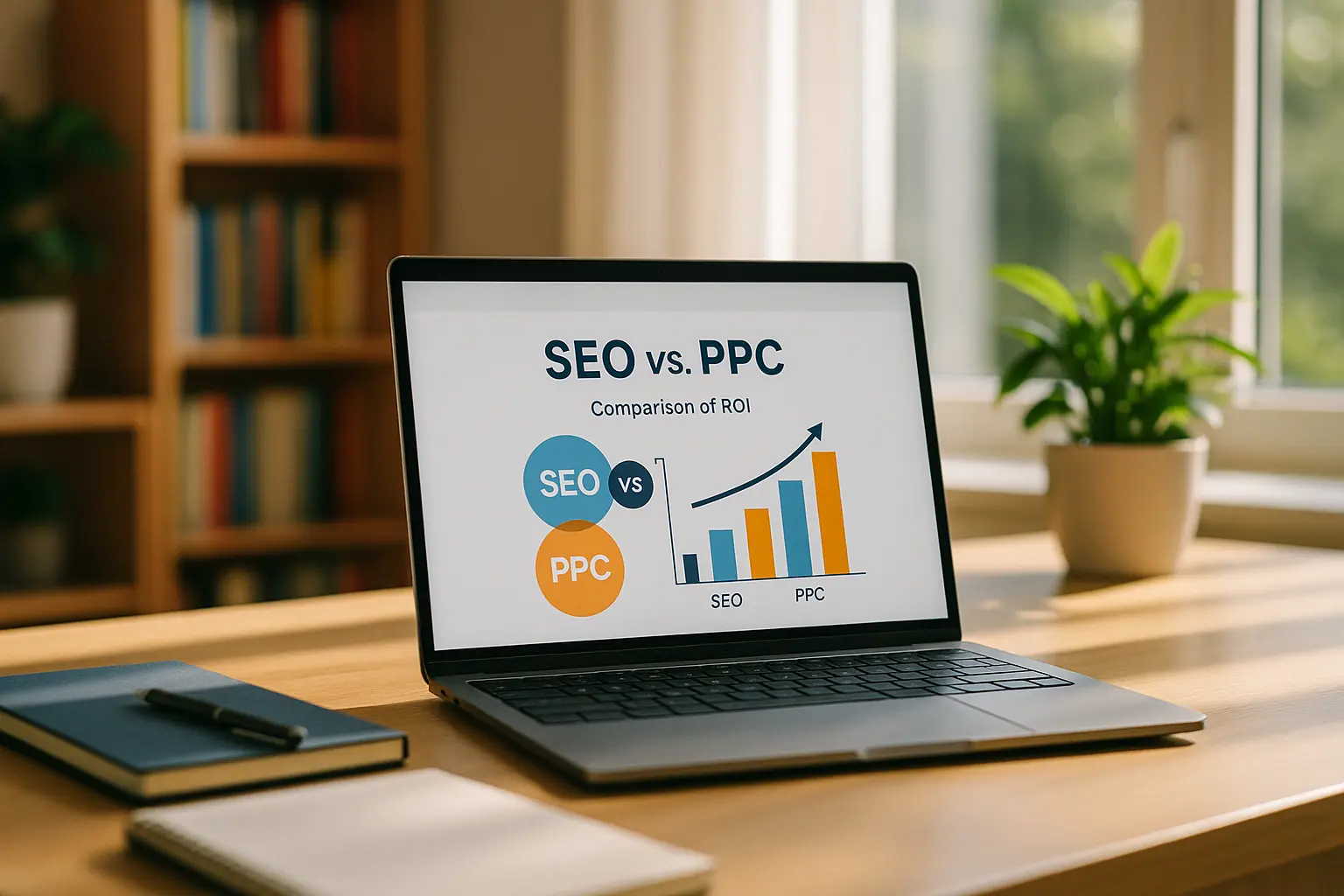
| Dimension | SEO | PPC |
|---|---|---|
| Marginal cost per visit | Zero; Google states organic inclusion costs nothing | Paid on every click, set by auction |
| Fixed cost | Content, engineering and time, spent before any result | Setup and management, small next to media spend |
| Speed of feedback | Months, with no guaranteed outcome | Same week |
| What can be measured cleanly | Very little without geographic or page level tests | A lot, most of it overstated without a holdout |
| Main structural risk | Impressions that no longer become clicks | Auction inflation and loss of targeting control |
| Stops working when | Slowly, over quarters | Immediately, the day the budget stops |
How we would actually decide
Not by comparing the two returns, which are not comparable, but by answering four questions in order.
- Does the demand already exist? If nobody searches for the problem you solve, both channels are the wrong instrument and the budget belongs somewhere else entirely.
- What is your cash horizon? A business that needs revenue this quarter cannot buy it with content. Paid search is the only one of the two that produces traffic on a schedule.
- Have you run a holdout? Before increasing paid budget, pause it in a set of comparable regions for a few weeks and measure total orders, not attributed ones. The eBay result exists precisely because somebody did this.
- Which queries are worth owning permanently? Those are the SEO targets. The rest, particularly seasonal and competitor terms, are cheaper to rent.
In most portfolios the answer ends up being both, in a specific order: paid search first to find out which intent converts, then organic investment aimed at the small number of queries that proved themselves. Using paid data to select organic targets is the one genuinely cheap synergy between the two, and it costs nothing beyond reading a search terms report honestly.
The claim to refuse
Whatever the split, one thing settles a vendor conversation quickly. Google writes, in its own guidance, that no one can guarantee a number one ranking and that agencies claiming a special relationship or a priority submission should be treated with suspicion. Any proposal that promises a position, or a return on ad spend, before running a single test is describing a hope rather than a plan. Ask instead what will be measured, against what baseline, and on what date the answer arrives.
The channel most exposed to the same attribution problem
If paid search overstates its contribution, retargeting overstates it more, and for the same structural reason.
Sources: Google Search Central documentation on whether you need an SEO, stating that Google never accepts money to include or rank sites in organic results, that appearing there costs nothing, and that no one can guarantee a number one ranking; Pew Research Center, short read published 22 July 2025, based on browsing data from more than 900 consenting US adults during March 2025, 68,879 unique Google searches of which 12,593 produced an AI summary, click rates of 8 percent with a summary against 15 percent without, and about 1 percent clicking a source inside the summary; Blake, Nosko and Tadelis, Consumer Heterogeneity and Paid Search Effectiveness, A Large Scale Field Experiment, Econometrica 83(1), 2015, pages 155 to 174; Google Ads announcements on AI Max for Search reaching general availability on 15 April 2026, the automatic upgrade of campaigns using automatically created assets and campaign level broad match from September 2026, the Dynamic Search Ads migration postponed to February 2027 on 11 June 2026, and Google’s own reported average of 7 percent more conversions or conversion value with the full feature suite. The Pew panel is United States only. Google’s performance figure is vendor reported and has not been independently verified. Nothing here predicts a return for any specific account. Updated August 2026.