On 24 March 2026, OpenAI conceded that the checkout it had put inside ChatGPT six months earlier “did not offer the level of flexibility that we aspire to provide”, handed payment back to the merchants and said it would concentrate on product discovery instead. Treated as a retreat, that reads like the end of the story. Treated as a correction, it tells you exactly which half of searchless shopping is already working and which half is still a building site.
Key takeaways
- Traffic to US retail sites from generative AI sources rose 693% year on year across November and December 2025, according to Adobe Analytics.
- That traffic converts better than the rest, by 42% in March 2026, a record in Adobe’s series.
- Two rival open protocols now govern how an agent reads your catalogue: ACP and Google’s Universal Commerce Protocol.
- Absolute volumes remain small, so this is an early-position play, not a channel migration.
What “searchless” actually describes
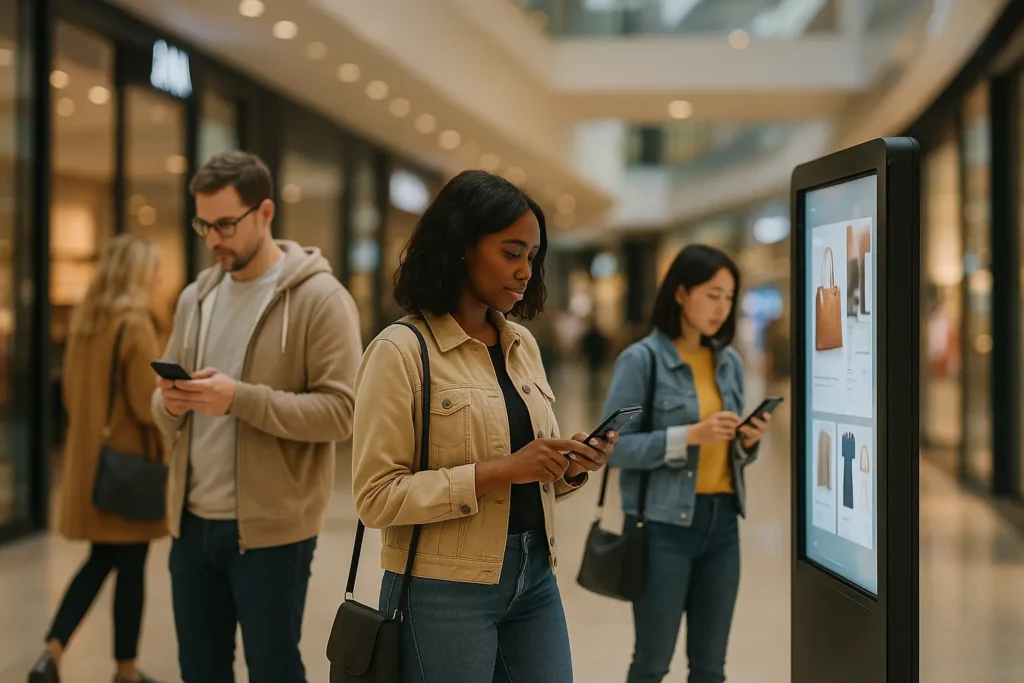
Searchless shopping is not the absence of search technology. It is the absence of the search box as the thing the shopper interacts with. The retrieval still happens, the ranking still happens, but it happens on the shopper’s behalf, inside an assistant that has already been told what the trip is for. Someone asks for a waterproof jacket that will survive a Scottish October under 200 pounds, and three options arrive with the reasoning attached.
That shift matters commercially for one reason: the surface that assembles the shortlist is no longer a page you can rank on in the way you are used to. It is a model reading structured data about your products, and the competition for that slot is decided by whether your catalogue is legible to a machine rather than by how well your landing page is written.
The numbers behind the trend, and their limits
The growth curve is real and it comes from measurement rather than from vendor enthusiasm. Adobe Analytics tracks referrals from generative AI tools to US retail sites, and its readings across the last three quarters are consistent.
| Metric | Reading | Period |
|---|---|---|
| Traffic to US retail sites from AI sources | +693% year on year | November to December 2025 |
| Same metric, following quarter | +393% year on year | January to March 2026 |
| Conversion rate against non-AI traffic | +31% | Holiday season 2025 |
| Conversion rate against non-AI traffic | +42% | March 2026 |
| Revenue per visit from AI referrals | +254% | Holiday season 2025 |
Two cautions belong next to that table. Percentages of a small base stay large for a while, and Adobe reports referred visits, meaning the shopper clicked through to the retailer rather than buying inside the assistant. Adobe’s own consumer reading is more sober than the traffic curve: 39% of shoppers said they had used AI for online shopping in some form, and 85% of those said it improved the experience. Useful, not yet dominant.
The plumbing fight that decides who gets recommended
Behind the consumer story sits a standards contest that started in earnest in late 2025. Three positions are worth knowing, because each asks something different of a merchant.
- The Agentic Commerce Protocol, co-developed by Stripe and OpenAI and released with Instant Checkout on 29 September 2025, initially with Etsy sellers. After the March 2026 rethink, OpenAI kept ACP but pointed it at discovery, with Target, Sephora, Nordstrom, Lowe’s, Best Buy, The Home Depot and Wayfair integrated.
- Google’s Universal Commerce Protocol, announced at NRF on 11 January 2026 and developed with Shopify, Etsy, Wayfair, Target and Walmart, with endorsements from more than twenty companies including Mastercard, Visa, Stripe, Adyen and American Express.
- The retailer’s own app inside the assistant, which is the route Walmart took, keeping account linking, loyalty and payment on its own side.
The lesson from the OpenAI reversal is that the hard part was never the recommendation. It was everything a checkout carries with it. Multi-item carts, loyalty tiers and, as of early 2026, collection and remittance of US state sales taxes all turned out to be slower to solve than product discovery.
Four things worth checking this quarter
None of this requires a rebuild, and we would be sceptical of anyone selling one. The practical work is unglamorous.
- Machine readability of product pages. Adobe’s 2026 analysis found product pages to be the weakest part of most retail sites for machine reading, well behind homepages and service pages. Structured product data, stated stock status and plain specification tables do more here than copywriting.
- Feed accuracy. An agent that surfaces a price you no longer charge produces an abandoned session and a support ticket. Price, availability and variant data need to be right at the source, not corrected at the page level.
- Attribution. AI referrals arrive with thin or absent referrer data in plenty of setups, so they quietly land in direct traffic. If you cannot see the channel, you cannot argue for it internally. This is the same discipline as any other measurement clean-up in your analytics setup, applied to a newer source.
- Return and support policy in text. Assistants quote policy. If yours only exists in an image or a PDF, it gets summarised badly or skipped.
Questions we get asked about this
Does searchless shopping mean SEO stops mattering?
No, and the framing is off. The same catalogue quality, technical hygiene and review depth that feed classic ranking also feed model retrieval. What changes is the destination: you are optimising to be cited in an answer as well as to be listed on a results page.
Should a small merchant integrate a commerce protocol now?
Only if the integration cost is genuinely low, which for most Shopify sellers it is, because the platform carries it. For a bespoke stack in mid-2026, waiting one more cycle is defensible while ACP and UCP settle their overlap.
Is this the same thing as social commerce?
They overlap without being identical. Both remove the query, but a social feed recommends without being asked a question, whereas an assistant answers a stated intent. The second carries more purchase signal, which is a plausible part of why the conversion gap runs in its favour.
How much of retail actually flows through this today?
A small share. The growth rates above are strong precisely because the starting point was near zero, and we would treat any 2026 forecast of agent-driven retail spending at the end of the decade as a projection rather than a plan.
Our reading is that the discovery layer deserves work now and the transaction layer deserves watching. The companies that quietly fixed their product data in 2025 are the ones showing up in answers in 2026, which is a dull conclusion for a subject this loud, and the one the evidence supports.
Wondering which tools are worth the licence fee?
The assistant layer is only one part of a stack that has changed a lot in eighteen months.
Sources: Adobe Analytics, generative AI referral traffic and conversion data for US retail sites, holiday season 2025 and first quarter 2026, published via Adobe Digital Insights; OpenAI and Stripe, launch of Instant Checkout and the Agentic Commerce Protocol, 29 September 2025; OpenAI agentic commerce update, 24 March 2026; Google, Universal Commerce Protocol announcement at NRF, 11 January 2026. Traffic and conversion figures are Adobe’s panel readings, not a census of the market. Updated August 2026.