
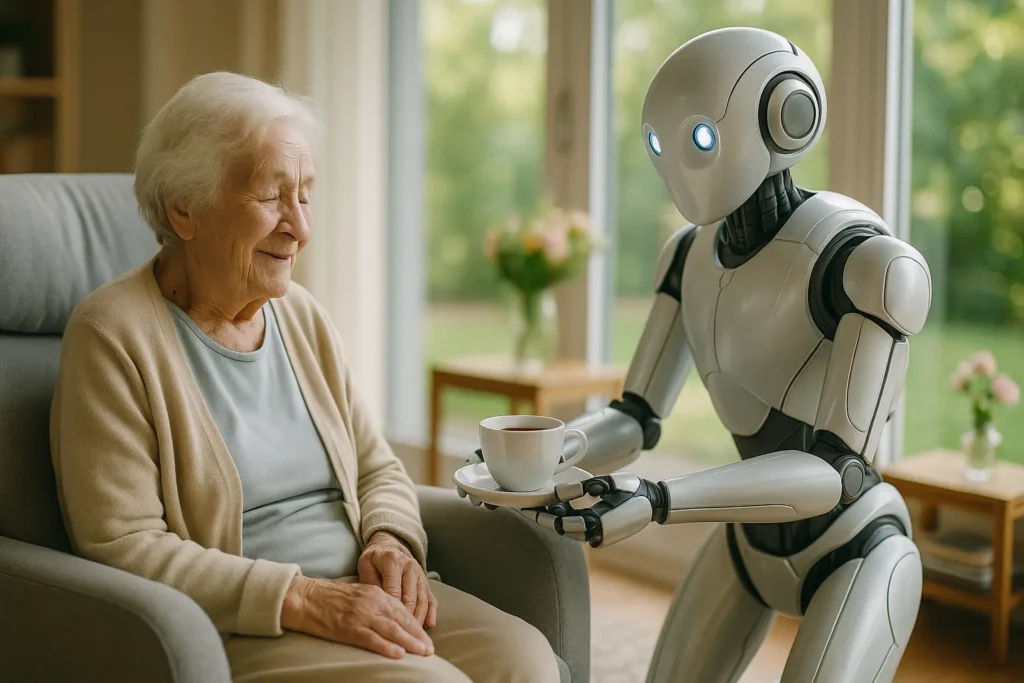
The most useful book written about eldercare robotics is called Robots Won’t Save Japan. James Wright spent eighteen months between 2016 and 2020 inside a Japanese care home he calls Sakura, watching the machines that were supposed to solve a labour shortage, and Cornell University Press published what he found in 2023. Staff did not like them. They cost money. And they created work, because the robots themselves needed tending. That is the least fashionable finding in the field and the one we keep coming back to.
Key takeaways
- WHO: the population aged 60 and over rises from 1 billion in 2020 to 1.4 billion by 2030.
- ISO 13482:2014 recognises exactly three types of personal care robot.
- Japan’s priority areas were revised in 2024 to 16 items across 9 categories.
- A 2024 meta-analysis of 8 randomised trials found social robots cut loneliness and depression.
The demographic pressure that funds the entire field
Every business case in this sector rests on the same set of numbers, so they are worth stating precisely rather than gesturing at. The World Health Organization projects that by 2030 one in six people worldwide will be aged 60 or over, with that group growing from 1 billion in 2020 to 1.4 billion. By 2050 it doubles again to 2.1 billion, and the number of people aged 80 or older is expected to triple between 2020 and 2050 to reach 426 million.
One further detail changes the market map. WHO expects two thirds of the world’s over-60 population to be living in low- and middle-income countries by 2050. A device engineered around Japanese or German reimbursement models does not automatically travel to where the demographic pressure will actually be greatest, and very little of the current product landscape is priced for that.
What a care robot legally is, and what it is not
There is one definition with regulatory weight, and it is narrower than the marketing category. ISO 13482:2014, on safety requirements for personal care robots, recognises three types and sets out the hazards and protective measures for each, including battery charging, robot motion, incorrect autonomous decisions, and humans simply not noticing the machine is there.
| ISO 13482 type | What it does | Dominant hazard |
|---|---|---|
| Mobile servant robot | Travels while performing tasks, handling objects or exchanging information | Collision and unexpected motion in a shared space |
| Physical assistant robot | Supports or augments the movement of a person’s body | Sustained physical contact and applied force |
| Person carrier robot | Transports a person from one place to another | Loss of stability with an occupant aboard |
Note what is missing from that table. A companion robot that talks and never touches anybody sits awkwardly against a standard written around physical contact, which is one reason the social robot segment has developed with far less normative scaffolding than the assistive one.
Japan has the most explicit public programme, run jointly by its Ministry of Health, Labour and Welfare and its Ministry of Economy, Trade and Industry. The priority areas began in 2013 with eight categories, were extended to thirteen in 2017, and were revised in 2024 into 16 items across 9 areas: transfer support, mobility support, toileting, bathing, monitoring and safety, care work support such as recording and information sharing, support for older adults with dementia, communication, and equipment that reduces the physical burden of care work. That list is a better description of the real product landscape than any market forecast.
The field evidence nobody quotes in the pitch deck
Wright’s ethnography is the closest thing the sector has to a longitudinal reality check, and its conclusions cut against the standard business case in three specific ways.
Robots did not save labour at Sakura. They required additional human effort to set up, move, charge, clean and troubleshoot, so staff time was displaced rather than freed. They were not cost-effective for many facilities once that effort was counted. And they tended to intrude on the parts of the job carers described as meaningful, the unhurried moments of contact, while leaving the administrative burden untouched.
We would be careful about generalising a single site studied between 2016 and 2020 to a 2026 product generation. But the mechanism Wright identifies is structural rather than technological: a device that needs tending consumes care labour, and care labour is the scarce resource the device was bought to conserve. The same trap shows up whenever automation is justified purely on headcount, which is the argument we picked apart in our look at whether AI can replace factory floor workers.
Where the evidence is genuinely strong
The companionship claim, which sounds the softest, is the one with randomised trials behind it. A meta-analysis published in the Journal of the American Medical Directors Association in 2024 pooled eight randomised controlled trials of social robots with older residents of long-term care facilities and found significant reductions in both depression and loneliness, with large effect sizes.
PARO, the therapeutic robot shaped like a baby harp seal, accounts for a good share of that literature. One randomised trial reported a mean difference of 7.0 points between intervention and control groups on the 20-item UCLA Loneliness Scale. More recent work has moved to community settings: a 2025 randomised trial in Japan enrolled 73 older adults living alone and reporting loneliness, assigning them to a four-week intervention with a humanoid communication robot.
These are small studies in specific populations, and effect sizes from small trials tend to shrink as evidence accumulates. They are still a firmer footing than anything the labour-saving argument has produced.
Questions worth settling before a purchase order
Which ISO 13482 type is this device, and does the vendor say so?
A vendor who cannot place their product in one of the three categories has usually not done a formal risk assessment against the standard. That is a procurement red flag rather than a technical one, and it costs nothing to ask.
Who charges, cleans and reconfigures it, and on whose shift?
This is the Sakura question, and in our experience it is the single best predictor of whether a deployment survives its first year. If the answer is that care staff will absorb it, the labour case is already negative.
Is the claimed benefit workload, safety, or wellbeing?
These three demand different evidence and rarely arrive together. Wellbeing has randomised trials. Safety has standards. Workload has vendor modelling and very little independent measurement, which is precisely the claim most business cases lean on hardest.
What happens to the data the device collects?
Monitoring systems in private homes generate continuous behavioural records about a person who may not have meaningfully consented to them. Whatever the applicable regime, the retention period and the recipient list need to be in writing before installation, not after a family asks.
Does it reduce human contact, and is that acceptable here?
A device that lets one carer cover more residents changes the ratio of human interaction per resident. Sometimes that is the point. It should be a decision somebody made deliberately rather than an emergent property of the rota.
Our honest reading of where this is heading: robotics will shape eldercare substantially, and mostly through unglamorous equipment that lifts, monitors and records, alongside a smaller category of companion devices with better clinical evidence than their reputation suggests. What it will not do, on current evidence, is close the care workforce gap. Anyone selling that specific promise is selling the one claim the field has repeatedly failed to demonstrate.
The same design problem, on an industrial scale
Machines built to work alongside people rather than behind a fence face an almost identical safety and acceptance challenge.
Sources: World Health Organization, Ageing and health fact sheet, for one in six people aged 60 or over by 2030, growth from 1 billion in 2020 to 1.4 billion by 2030, 2.1 billion by 2050, the tripling of the over-80 population to 426 million between 2020 and 2050, and two thirds of the over-60 population living in low- and middle-income countries by 2050. ISO 13482:2014, Robots and robotic devices, Safety requirements for personal care robots, for the three recognised types and the associated hazards. Japanese Ministry of Health, Labour and Welfare and Ministry of Economy, Trade and Industry, Priority Areas for the Use of Caregiving Technology, revised June 2024 into 16 items across 9 areas, following the eight-area programme launched in 2013 and its extension to thirteen areas in 2017. James Wright, Robots Won’t Save Japan: An Ethnography of Eldercare Automation, Cornell University Press, 2023, based on eighteen months of fieldwork conducted between 2016 and 2020. Meta-analysis of eight randomised controlled trials on social robots, depression and loneliness among long-term care residents, published in the Journal of the American Medical Directors Association, 2024. Randomised trial of PARO reporting a mean difference of 7.0 on the 20-item UCLA Loneliness Scale. Randomised controlled trial of a humanoid communication robot with 73 community-dwelling older adults in Japan, published in JMIR Aging, 2025. This article is general information about a technology sector and is not clinical or care advice; decisions about the care of an individual belong with qualified professionals. Updated August 2026.