Ask ten marketing teams why their funnel is underperforming and nine will point at the top of it: not enough traffic, not enough leads, not enough budget. The more useful answer usually sits further down, in the gap between what the dashboard recorded and what the buyer actually did before showing up on it.
Key takeaways
- Gartner surveyed 646 B2B buyers between August and September 2025 and published the results on 9 March 2026: 67% prefer a rep-free experience.
- That figure stood at 61% in Gartner’s equivalent release of June 2025.
- 45% of the buyers surveyed said they used AI tools during a recent purchase.
- Google’s Decoding Decisions research describes exploration and evaluation as a loop, not consecutive stages.
A funnel describes your pipeline, not your buyer
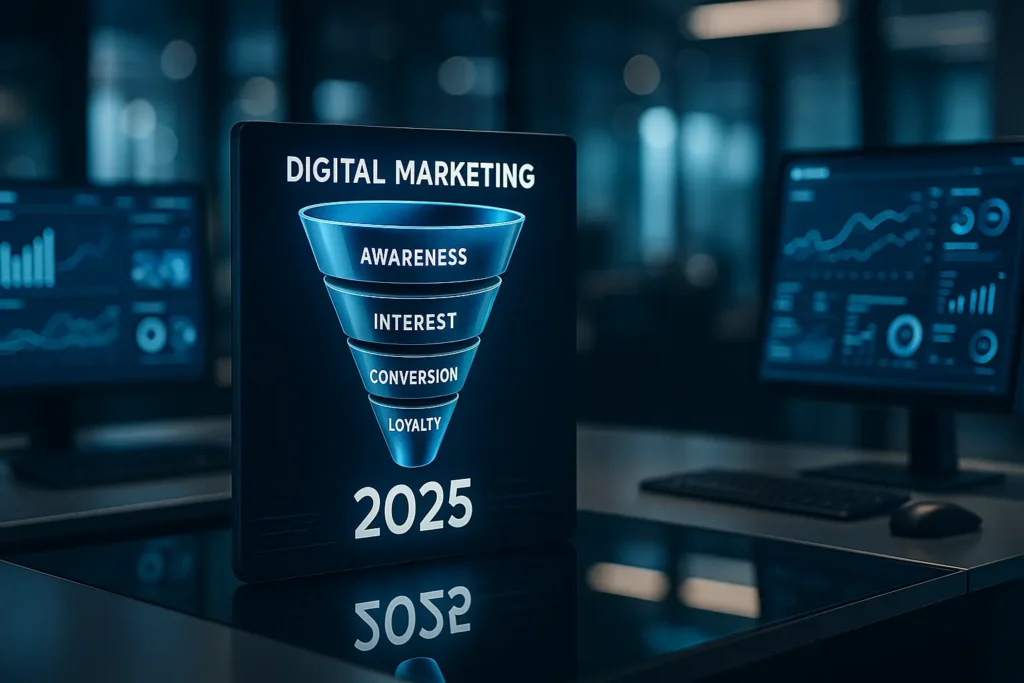
A funnel is a counting device. It takes a population, sorts it into stages, and reports how many survive each one. That is genuinely useful for forecasting revenue and sizing a sales team, and we have no interest in throwing it away. It stops being useful the moment it gets read as a claim about human behaviour, because nobody wakes up in the awareness stage.
The model quietly assumes three things. That movement is one-directional. That the stages are mutually exclusive. That a supplier is present at each of them. Remove those three assumptions and you still have a perfectly good accounting frame, and a very poor design brief.
What the 2026 buyer data actually says
The clearest recent number comes from Gartner, which surveyed 646 B2B buyers between August and September 2025 and published the findings on 9 March 2026. Sixty-seven percent said they would prefer a rep-free buying experience. In the equivalent Gartner release of June 2025 that figure was 61%, so the direction of travel is not subtle. Forty-five percent also reported using AI tools during a recent purchase.
Set that against Gartner’s longer-running measure that buyers spend roughly 17% of the total buying journey meeting with all potential suppliers combined. Divide that slice across three or four shortlisted vendors and the direct contact time any single supplier gets is thin. Most of what determines the outcome happens where you are not in the room.
On the consumer side, Google’s Decoding Decisions work with The Behavioural Architects reached a compatible conclusion from a different angle. It described the space between trigger and purchase as a messy middle, where people cycle between exploration, an expansive mode that adds options, and evaluation, a reductive one that removes them. They repeat the cycle as often as they need. The research did not say the funnel’s outline was wrong. It said the ordering was not real.
The part your dashboard cannot see
If most of the decision happens away from your properties, most of the evidence for it never reaches your analytics. Someone reads a comparison in a private Slack group, asks two colleagues, puts three questions to an assistant, then lands on your pricing page already close to decided. That session is logged as direct traffic on a single touch, and the report makes the funnel look efficient rather than invisible.
This is why “our funnel is broken” so often turns out to mean “our attribution is blind”. It is the same mechanism we picked apart in our piece on how dark social is killing your marketing attribution, seen from the revenue side rather than the measurement side.
Designing for the loop rather than the stage
Building for a loop means asking a different question of every asset you own. Not “which stage is this for”, but “does this help someone explore, or does it help someone justify”. Those are the two jobs that actually get done, and most libraries are heavily weighted towards the first.
| Funnel thinking | Loop thinking | |
|---|---|---|
| Job of a page | Move someone to the next stage | Answer the question being asked right now |
| Gating | Trade information for contact details | Gate what needs a conversation, publish the rest |
| Role of sales | Guide the buyer through the steps | Be available at the point of doubt, not before |
| Success signal | Stage-to-stage conversion rate | Branded search, self-reported source, return visits |
What we would change first
Five moves, in the order we would attempt them, none of which require a new platform.
- Publish pricing, or the most honest approximation your commercial model allows. A buyer who cannot build a budget case without a call will often build it with a competitor instead.
- Write your own comparison page. If you do not, the version that circulates will be written by someone with no incentive to be fair to you.
- Un-gate the material that helps someone justify a decision internally, and keep the gate on what genuinely requires a conversation. Reverse the default rather than abolishing it.
- Make your claims quotable. Clear statements, named sources, visible dates. With 45% of surveyed buyers using AI tools during a purchase, being cited accurately is now part of being found.
- Treat email as permission, not a stage. Consent and one-click unsubscribe are legal obligations under the GDPR in Europe and the CAN-SPAM Act in the United States, and they double as the cleanest engagement signal you own outright.
Objections we get
So the funnel is dead?
No, and we would be suspicious of anyone who says so. It remains a sound forecasting instrument for a pipeline. It is simply a bad map of a buyer’s head, and the two uses have been confused for years.
Doesn’t this just mean producing more content?
Usually the opposite. Loop thinking tends to cut volume and raise specificity, because the assets that survive the audit are the ones that answer a question someone actually typed.
How do you measure something that loops?
Imperfectly, and honestly. Self-reported attribution on the form, branded search volume, direct traffic to high-intent pages, and win-rate movement over quarters rather than weeks. None of these are precise. All of them beat a precise number describing something that did not happen.
Does any of this apply outside B2B?
The Gartner figures are B2B. The Google research is consumer. That they point the same way is the reason we take it seriously rather than treating it as one sector’s quirk.
Our working position for the rest of 2026: keep the funnel on the forecast sheet, and take it out of the creative brief. The teams we see doing well are not running a better sequence. They are simply easier to find, easier to check, and easier to argue for when nobody from their side is in the room.
Building one from the ground up instead?
The mechanics still matter once you have decided what the sequence is really for.
See how to build a high-converting sales funnel from scratch
Sources: Gartner, Gartner Sales Survey Finds 67% of B2B Buyers Prefer a Rep-Free Experience (9 March 2026, survey of 646 B2B buyers fielded August to September 2025) and Gartner Sales Survey Finds 61% of B2B Buyers Prefer a Rep-Free Buying Experience (25 June 2025); Gartner, The B2B Buying Journey; Google and The Behavioural Architects, Decoding Decisions: making sense of the messy middle. Updated August 2026.