Most poultry vaccination plans start life as a calendar: four dates, four products, printed and pinned to the wall of the feed room. The virus does not read calendars. What decides whether a programme holds is a number most producers never see, an antibody curve that shifts from flock to flock, and a set of handling details that can quietly neutralise a well-chosen vaccine before it reaches a bird.
Key takeaways
- WOAH defines virulent Newcastle disease by an ICPI of 0.7 or greater in day-old chicks, or a multibasic F0 cleavage site with phenylalanine at residue 117.
- EU criteria for routine-vaccination programmes cap live vaccine strains below an ICPI of 0.4 or 0.5, depending on dose.
- Mesogenic vaccine strains sit around ICPI 1.4, which places them inside the disease definition itself.
- Vaccination reduces clinical disease and shedding. It does not prevent infection, so biosecurity is not the optional half.
Start from the definition, not the calendar
Newcastle disease is a legal category before it is a clinical one, and that changes what you are allowed to buy. WOAH defines it as infection of poultry with a virulent strain of avian paramyxovirus 1, virulence being settled by one of two tests: an intracerebral pathogenicity index (ICPI) of 0.7 or greater in day-old chicks, or multiple basic amino acids at the C-terminus of the F2 protein together with phenylalanine at residue 117. Anything meeting either criterion is a notifiable event, not a management problem.
The naming has also moved on. The agent now sits in the genus Orthoavulavirus, subfamily Avulavirinae, family Paramyxoviridae, rather than the genus Avulavirus printed in most pre-2019 poultry manuals. Cosmetic on the farm, substantive in any file that crosses a border.
One more number is worth separating out. For trade and control purposes the WOAH Terrestrial Code, chapter 10.9, sets the incubation period at 21 days. That is a regulatory window built to be safe, not a clinical observation, and it sits well beyond the 2 to 15 days seen in the field. Confusing the two produces surveillance plans that stop looking far too early.
Four families, and the constraint that picks between them
The choice of vaccine is rarely a question of which product is best. It is a question of which constraint binds hardest on your site: hatchery equipment, labour, field pressure, or the jurisdiction you sell into.
| Vaccine family | Typical strains | Where it fits | The binding constraint |
|---|---|---|---|
| Live lentogenic | Hitchner B1, La Sota, VG/GA | Priming and repeat boosting by mass application | Neutralised by maternal antibody, and by any disinfectant left in the water line |
| Live mesogenic | Komarov, Roakin, Mukteswar | Endemic regions only, on already primed birds | ICPI around 1.4, so the strain itself meets the disease definition |
| Inactivated oil emulsion | Whole-virus adjuvanted | Pre-lay in layers and breeders, for long systemic titres | One injection per bird, and a single freezing event ruins the emulsion |
| Recombinant vector | HVT-NDV, in ovo or day-old | Hatcheries already running a Marek’s line | Slow onset, and a second HVT product cannot simply be layered on later |
The strain that is routine in one country and reportable in another
Mesogenic strains deserve their own paragraph, because the older literature recommends them freely and the regulatory position has hardened underneath that advice. These viruses carry two pairs of basic amino acids at the F0 cleavage site and return ICPI values in the region of 1.4. Read against the criteria above, a bird carrying one of them is, on the letter of the definition, a bird infected with Newcastle disease.
The European criteria make the gap explicit. Commission Decision 93/152/EEC requires live ND vaccine strains used in routine programmes to fall below an ICPI of 0.4 at a dose of at least 108 EID50, or below 0.5 at lower doses. No mesogenic strain comes close. Their use survives only where the disease is endemic and that trade-off has been accepted deliberately, which is a policy decision taken well above the level of the farm, not a technical upgrade a producer picks for extra durability.
Sequencing the programme around maternal antibody
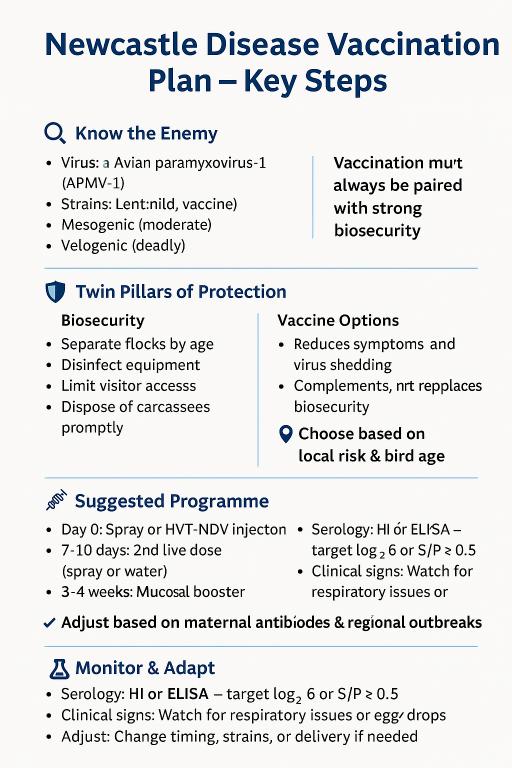
The classic four-step sequence still works, provided each step is triggered by a measurement rather than by a date.
- Day-old. Coarse spray of a live lentogenic strain, or a subcutaneous or in ovo HVT-NDV vector at the hatchery. The vector travels past maternal antibody, which is its real advantage, but its onset is slow and it will not cover an early field challenge alone.
- 7 to 10 days. A second live application once maternal titres have decayed enough for the vaccine to replicate. Applying it too early wastes the dose entirely rather than partially.
- 3 to 4 weeks. A further live booster aimed at mucosal immunity in the upper respiratory tract, which is where field virus arrives first.
- Pre-lay, for layers and breeders. Inactivated oil emulsion for durable systemic antibody through lay, and for the maternal antibody that will protect the next generation of chicks.
Serology turns that outline into a plan. Haemagglutination inhibition or ELISA on a flock sample three to four weeks after each key application tells you whether the dose landed. Sampling before the first live application tells you something more useful still: when the maternal antibody window actually closes in this flock, from this breeder source.
Where good plans die: delivery and cold chain
A correct product on a correct date still fails if the delivery is wrong, and the failure stays invisible until the titres come back flat.
For spray, droplet class is the variable that matters. Below 50 microns the aerosol reaches deep into the respiratory tract and provokes reactions; 50 to 100 microns is a fine spray; 100 to 300 microns is the coarse range used on farm to target the upper tract, calibrated in the order of 250 ml per 1,000 birds. For drinking water, stop all water-line disinfectant 24 hours beforehand, add skimmed milk powder at 2 to 2.5 g per litre roughly 20 minutes before the vaccine goes in, then plan for the whole dose to be drunk inside a 2 to 4 hour window.
Cold chain is the other silent killer. Conventional inactivated and freeze-dried live products hold at 2 to 8 °C. Cell-associated HVT vectors live in liquid nitrogen at -196 °C, thawed quickly in a water bath at 20 to 30 °C and never refrozen. A single freezing event separates an oil emulsion into adjuvant and antigen, and the vial looks entirely normal on the bench.
Three objections we hear on farm
The flock was vaccinated and still broke. Did the vaccine fail?
Not necessarily, and this is the most consequential misunderstanding in the subject. Vaccination against Newcastle disease is designed to prevent clinical disease and reduce virus shedding, not to prevent infection, and WOAH is explicit that vaccinated birds can be infected and can shed. A break with low mortality and a measurable drop in production is often the vaccine doing exactly what it was bought to do, against a challenge biosecurity should have stopped upstream.
Can we run the programme without serology?
You can run it. You cannot correct it. Without titres there is no way to separate a schedule mistimed against maternal antibody from a product warmed in transit, and the two need opposite fixes. PCR on any unexplained respiratory noise or egg drop remains a separate, non-negotiable step, because vaccinated birds can mask a field strain.
How much does biosecurity really change the arithmetic?
Enough that WOAH devotes chapter 6.5 of the Terrestrial Code to it: physical separation of zones, one-way flow of birds and material in the direction of airflow, showering and site-supplied clothing at entry, cleaning and disinfection of vehicles before every load. Where those hold, a vaccination programme absorbs small breaches. Where they do not, it is being asked to do a job it was never designed for.
Thinking about the logistics rather than the biology?
Vaccine cold chain is a supply chain problem before it is a veterinary one, and recent years supplied a hard lesson in how those fail.
Read what the shipping crisis taught us about global industry
Sources: WOAH Terrestrial Manual, chapter on Newcastle disease (infection with Newcastle disease virus), for the virulence definition, the taxonomic placement in the genus Orthoavulavirus, subfamily Avulavirinae, family Paramyxoviridae, and the statement that vaccination does not prevent infection or shedding; WOAH Terrestrial Animal Health Code, chapter 10.9 for the 21-day incubation period used for Code purposes and chapter 6.5 for biosecurity procedures in poultry production; Commission Decision 93/152/EEC of 8 February 1993 for the ICPI criteria applying to live vaccines in routine programmes (below 0.4 at a dose of at least 108 EID50, below 0.5 at lower doses, master seed not exceeding 0.4); published characterisation of mesogenic vaccine strains reporting two pairs of basic amino acids at the F0 cleavage site and ICPI values around 1.4. Droplet classes, water-line preparation and cold-chain figures follow current vaccine manufacturer and hatchery technical documentation. This article is general industry information and does not replace the product label or the advice of the veterinarian responsible for your flock. Authorisation and notification duties differ by country: veterinary biologics are licensed in the United States by the USDA APHIS Center for Veterinary Biologics, and in the European Union under Regulation (EU) 2019/6. Updated August 2026.