Nobody actually objects to wasting less. What people object to is the look that seems to come attached: the jute, the mismatched jars, the wooden brush propped in a mug, the general air of a room that would like you to know it is trying. The good news is that the aesthetic and the outcome are not connected, and the changes that matter most are the ones nobody can see.
Key takeaways
- UNEP counted 1.05 billion tonnes of food wasted in 2022, with 60% of it at household level.
- UK homes bin 4.4 million tonnes of edible food a year, around £1,000 for a household of four.
- The high-impact changes are storage, portioning and stock rotation, all of them invisible.
- The “eco” look comes from mismatched containers and visible branding, not from sustainability.
The biggest lever is food, not packaging
The scale is worth stating before any shopping happens. The UN Environment Programme’s Food Waste Index Report 2024 found that 1.05 billion tonnes of food were wasted in 2022, roughly a fifth of all food available to consumers, and that households were responsible for 60% of it, or 631 million tonnes. Averaged globally, that comes to about 132 kg per person per year including inedible parts such as peel and bone.
The national picture is sharper. WRAP, the UK charity that runs Love Food Hate Waste, reports that UK homes throw out 4.4 million tonnes of edible food annually, costing about £1,000 a year for a household of four and £17 billion nationally, with roughly 16 million tonnes of greenhouse gas emissions attached. In a release dated 9 March 2026 it noted that 64% of UK adults still believe some food waste is simply unavoidable.
Set that against a beeswax wrap. The wrap is fine. It is also a rounding error next to a bag of salad going soft in a drawer, and it is the part everyone can see, which is exactly why the conversation keeps drifting towards it.
Three changes that do most of the work
These are ranked by effect, not by visibility, and none of them alters how a kitchen looks.
- Store food for its actual failure mode. Most food is binned because it degraded faster than expected, not because it was forgotten in principle. Herbs in water, bread in a closed box rather than a paper bag, dairy on a middle shelf rather than in the door where the temperature swings. This is the single highest-return habit and it costs nothing.
- Shop against a plan, not against a mood. Deciding four meals before going out, and buying loose quantities for them, removes the surplus that generates most of the waste. WRAP’s own campaigning points at portion size and meal planning for the same reason.
- Give leftovers a fixed address. One clearly designated shelf, at eye level, checked first. Waste is usually a visibility failure rather than an intention failure, and a shelf solves it more reliably than a resolution does.
Where the “eco” look actually comes from
The aesthetic that people are trying to avoid is rarely caused by sustainability. It is caused by three specific things, and each has a design fix.
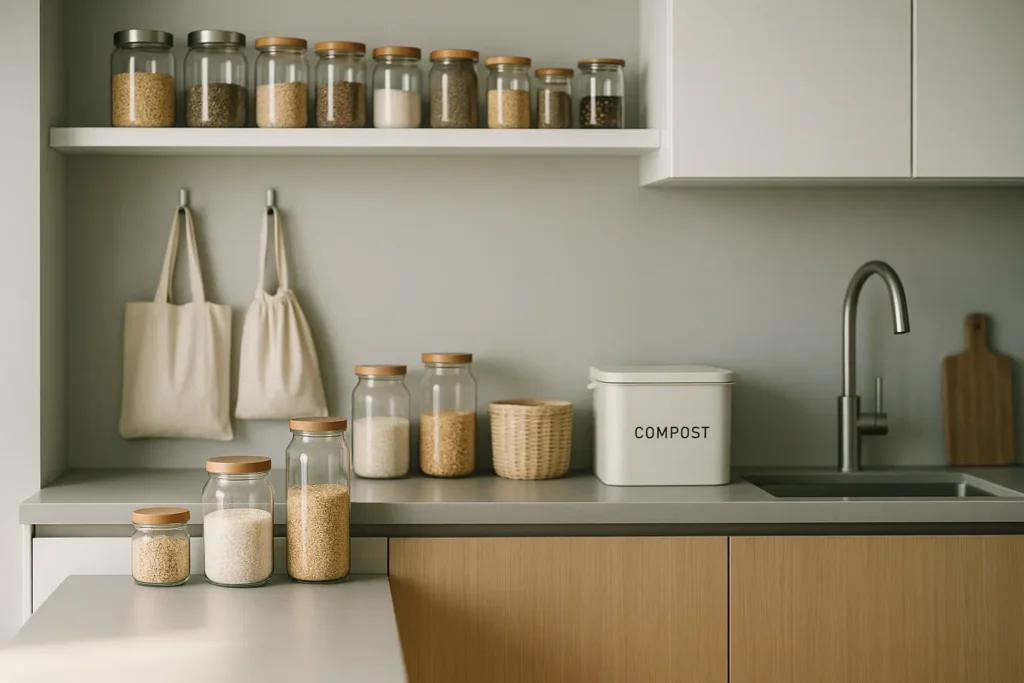
Mismatched containers. A shelf holding four jar shapes, two plastic tubs and a repurposed sauce jar reads as improvised. The same shelf holding one jar in three sizes reads as a system. Decanting into a single container family is the fastest visual upgrade in this whole exercise, and it belongs in the same category as the other small decorating moves professionals rely on. It also makes stock levels legible at a glance, which reduces duplicate buying.
Visible branding. Refill and bulk products often arrive in packaging that shouts about its own virtue. Decanting removes it. So does turning labels to the wall, which is free.
Texture drift. Jute, unfinished bamboo, hessian and raw cork all carry a strong signal, and stacking them multiplies it. One natural texture in a scheme reads as warmth. Four read as a manifesto. Stainless steel, glass, enamel and dark-stained wood are all durable, all reusable and all visually neutral, and choosing within one material family is the same discipline that makes any other room look finished.
What we would not bother with
- Replacing things that still work. Binning a functioning plastic container to buy a glass one is a net loss on every measure that counts.
- Open-shelf displays of rarely used items. Bulk grains on show look excellent for a month and dusty after six.
- A countertop compost caddy chosen for looks. It will be opened several times a day. Choose the one that seals and hide it under the sink. In England, weekly household food waste collections began rolling out from 31 March 2026 under the Simpler Recycling reforms, which makes the caddy question practical rather than aspirational for many homes.
- Anything bought in a set of twelve. Reusables only pay back if they are used, and most kitchens need two or three of anything, not a starter kit.
Straight answers
Is a genuinely zero-waste kitchen realistic?
Not literally, for almost anyone. Peel, bone and packaging that has no alternative will always exist. Cutting household food waste substantially is realistic, and it is where nearly all of the environmental and financial benefit sits.
Do sustainable swaps cost more?
Up front, often yes. Over time the arithmetic is dominated by food, not equipment: a household of four in the UK bins roughly £1,000 of edible food a year according to WRAP, which dwarfs the cost of any container.
Can this work in a rented kitchen?
Better than most design projects, because none of it is structural. Containers, storage habits and a bin arrangement travel with you, and none of them requires a landlord’s permission.
The version of this that lasts is not the one photographed on day one. It is the one where the reusable things get used, the food gets eaten, and a visitor would have no particular reason to comment on any of it.
Curious how material choice carries meaning elsewhere in the home?
The same logic that makes one container family look deliberate applies across every surface in a room.
Read how materials tell a story, from clay walls to smart glass
Sources: UNEP Food Waste Index Report 2024, published 27 March 2024, covering 2022 data; WRAP (Waste and Resources Action Programme) UK food waste and food surplus figures and press release of 9 March 2026 for Food Waste Action Week; Simpler Recycling reforms in England, weekly food waste collections from 31 March 2026. UK figures apply to the UK only and are not globally representative. Updated August 2026.